There are times when we cannot remember some simple formula for a maths application.
Or we have doubts to the some maths working especially when many parameters got involved.
I ave a simple tip.
Look at the units for the numerical item.
Example:
To calculate distance travelled by a vehicle, given the speed it goes and time taken,
we look at the speed's units.
Unit: m / s
What does it tell?
Yes, it gave an indirect answer that speed = distance / time.
Thus if time is given, we are able to know that we just need to multiple speed by time in order to retain only the distance.
(m / s) x s = m (only) ==> Distance
The above allow us to use units to deduce the working (and formula).
Hence, we should not overlook the power of knowing units.
It is simply disappointing to sometimes see people missing out on writing the units for certain parameters. Maths loses its value simply by ignoring this step.
Therefore treasure this little but powerful "units".
:-)
Maths is interesting!
.
Showing posts with label speed. Show all posts
Showing posts with label speed. Show all posts
Wednesday, 25 May 2011


Sunday, 3 October 2010
Pointers in Teaching, Learning Speed
.
At elementary level in maths education, speed is always a challenging topic for learners.
It caught my attention and I started wondering why?
Many mistakes can be made when dealing with these types of questions.
After studying the various mistakes made by learners, I came to a few conclusion that I like to share here.
How to avoid confusion in doing Speed questions in maths:-
1) Speed involves two parameters, namely, distance and time.
This is the key issue. Dealing with one parameter is already a challenge, and dealng with two is always a "headache".
The concept, has thus to be clearly addressed upon, before the ratio of distance and time leading to speed can be fully understood.
What is distance?
What is time?
These 2 items are variable in nature. They change in value.
They causes confusion when lumped together!
Examples of daily activities will help in this case.
Quote cases like running in a race, where the champion came back in the shortest time covering the same distance as all others.
Get the concept of distance versus time into them.
Also FAST and SLOW relation to speed.
2) Error in units:-
Break up the tasks of calculating km, m or cm and sec, hours, minutes separately.
In other words,deal with one item at a time.
Use basic unit if possible to reduce chances of making costly errors.
The learners have to handle the logical part of the question, and also the mechanical part of unit manipulation in speed problems.
Tell them to find one thing at a time, and the need for doing that. Be patience is the message.
3) Draw out a pictorial image of the question.
This method will help some kids to visualise the real issue.
By having drawn the length for distance to be covered (or covered), they will have a better idea of what distance is about in the maths question. They will not have to "keep" this disatnce in their mind together with the problematic "time" condition.
Use the seeing method helps them clear any doubts and can also reduce mistakes in interpreting the question.
There will definitely be more pointers to be added to my three above.
But with these 3 basic issues settled, most of the queries about speed and its maths problems should be clearer.
If you have any other pointers, you may share in the comment space.
Cheers :-)
Maths is interesting, I suppose you cannot agree more.
.
At elementary level in maths education, speed is always a challenging topic for learners.
It caught my attention and I started wondering why?
Many mistakes can be made when dealing with these types of questions.
After studying the various mistakes made by learners, I came to a few conclusion that I like to share here.
How to avoid confusion in doing Speed questions in maths:-
1) Speed involves two parameters, namely, distance and time.
This is the key issue. Dealing with one parameter is already a challenge, and dealng with two is always a "headache".
The concept, has thus to be clearly addressed upon, before the ratio of distance and time leading to speed can be fully understood.
What is distance?
What is time?
These 2 items are variable in nature. They change in value.
They causes confusion when lumped together!
Examples of daily activities will help in this case.
Quote cases like running in a race, where the champion came back in the shortest time covering the same distance as all others.
Get the concept of distance versus time into them.
Also FAST and SLOW relation to speed.
2) Error in units:-
Break up the tasks of calculating km, m or cm and sec, hours, minutes separately.
In other words,deal with one item at a time.
Use basic unit if possible to reduce chances of making costly errors.
The learners have to handle the logical part of the question, and also the mechanical part of unit manipulation in speed problems.
Tell them to find one thing at a time, and the need for doing that. Be patience is the message.
3) Draw out a pictorial image of the question.
This method will help some kids to visualise the real issue.
By having drawn the length for distance to be covered (or covered), they will have a better idea of what distance is about in the maths question. They will not have to "keep" this disatnce in their mind together with the problematic "time" condition.
Use the seeing method helps them clear any doubts and can also reduce mistakes in interpreting the question.
There will definitely be more pointers to be added to my three above.
But with these 3 basic issues settled, most of the queries about speed and its maths problems should be clearer.
If you have any other pointers, you may share in the comment space.
Cheers :-)
Maths is interesting, I suppose you cannot agree more.
.
Friday, 2 April 2010
Tips on Avoiding Mistakes (Unit writing)
.
Maths involves many traps.
Any one of this traps will make the solution looks odd or even to the extent of wrong answer.
What are this traps ?
Mathematical operators, symbols, units, transferring of numbers, size of the written symbols, decimal points are some of the examples of traps contributing to the error.
Here I would like to mention about "unit".
In maths, calculation of items are aplenty. One of them is the study of speed.
In the topic of speed, students are dealing with three basic elements.
They are the distance, time and their ratio (speed).
All these three elements have different units all to themselve.
Distance == metre
Time == second
Speed == metre / sec
There are variations of the above.
km, mintues, hours, km / h, m / min, etc
Do you now see the danger?
If you are dealing with so many units in one maths question, what are the chance of making mistakes?
If you are careful, the chance is low, but it does not mean zero.
You still have to be careful.
How to avoid having mistakes due to this undesired slip?
One tip is to write down the units in the working steps.
Do not leave the numerical answer (in the working) without any unit indicated.
Make clear the item of interest, whether it is distance or time by reflecting the unit besides the number.
Example: 5 km, 40 sec.
A complete maths example will push the message across, thus ....
Example :
Alan travelled at a speed of 60 km / h for 2 h. After that, he slowed down by 20 km / h and travelled the last quarter of the journey at this new speed. How long did he take to travel?
Working:
60 x20 = 120
120 / 3 = 40
60 - 20 = 40
40 / 40 = 1
2 + 1 = 3
Answer: 3 hrs.
What is your comment on the working?
I personally feel uncomfortable. What about you?
The danger in that sort of working is the lack of showing the actual item in the calculation.
It does not allow a good way for checking after completing the worksheet (if many maths problems are within).
Clearly writing the units will, at least, make checking later an easier task.
It also allows the marker (teacher) a clearer picture instead of guessing what you intend to show.
Along the way, during the working, you will also have a lesser chance of getting confuse as the items are listed with the proper message (through the units).
So are you convince proper unit presentation is worth the while?
A pointer for your thoughts.....
Cheers :-D
.
Maths involves many traps.
Any one of this traps will make the solution looks odd or even to the extent of wrong answer.
What are this traps ?
Mathematical operators, symbols, units, transferring of numbers, size of the written symbols, decimal points are some of the examples of traps contributing to the error.
Here I would like to mention about "unit".
In maths, calculation of items are aplenty. One of them is the study of speed.
In the topic of speed, students are dealing with three basic elements.
They are the distance, time and their ratio (speed).
All these three elements have different units all to themselve.
Distance == metre
Time == second
Speed == metre / sec
There are variations of the above.
km, mintues, hours, km / h, m / min, etc
Do you now see the danger?
If you are dealing with so many units in one maths question, what are the chance of making mistakes?
If you are careful, the chance is low, but it does not mean zero.
You still have to be careful.
How to avoid having mistakes due to this undesired slip?
One tip is to write down the units in the working steps.
Do not leave the numerical answer (in the working) without any unit indicated.
Make clear the item of interest, whether it is distance or time by reflecting the unit besides the number.
Example: 5 km, 40 sec.
A complete maths example will push the message across, thus ....
Example :
Alan travelled at a speed of 60 km / h for 2 h. After that, he slowed down by 20 km / h and travelled the last quarter of the journey at this new speed. How long did he take to travel?
Working:
60 x20 = 120
120 / 3 = 40
60 - 20 = 40
40 / 40 = 1
2 + 1 = 3
Answer: 3 hrs.
What is your comment on the working?
I personally feel uncomfortable. What about you?
The danger in that sort of working is the lack of showing the actual item in the calculation.
It does not allow a good way for checking after completing the worksheet (if many maths problems are within).
Clearly writing the units will, at least, make checking later an easier task.
It also allows the marker (teacher) a clearer picture instead of guessing what you intend to show.
Along the way, during the working, you will also have a lesser chance of getting confuse as the items are listed with the proper message (through the units).
So are you convince proper unit presentation is worth the while?
A pointer for your thoughts.....
Cheers :-D
.
Monday, 18 August 2008
Linear | Angular Speed
Speed has two definitions:
Linear speed is defined as the distance travelled for a given time.
Angular speed is defined as the angle covered for a given time.
Are they proportional ?
Or are they related in any sense?
Let us take 2 pendulums hung on a slim rotating rod for analysis.
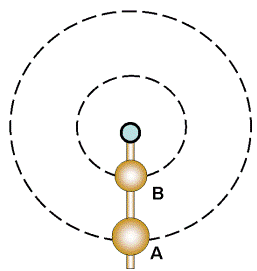
If the 2 pendulums (A and B) rotate one full cycle, the time taken by them is the same.
They covered the same amount of angular distance (360 degree) within the same amount of time.
This showed that they have exactly the SAME angular speed.
But is the Linear speed similar?
The length of the 2 circumferences travelled by the individual pendulums are not the same.
The linear length or distance is therefore NOT the same.
Length = 2 x (pi) x radius.
They took the same time to complete one full cycle, though.
The linear speed is thus DIFFERENT, having travelled different length for the same amount of time.
In this case, the angular speed is the SAME whereas the linear speed is different. Pendulum A has a higher linear speed compared with pendulum B.
Can the angular speed be different and linear speed made to be the same?
If the same slim rod is used, the answer is NO.
But if they are held by different rods, like that of the traditional analogue clock, the answer is YES.
For the linear speeds to be the same, pendulum A has to take a longer time to complete one cycle compared to pendulum B timing.
In this case, their linear speeds are the SAME while the angular speed will be DIFFERENT. This is so, since, same angular coverage but different time taken.
Why are we talking so much about this?
This is an "old" principle that was applied to the famous grandfather's clock. The setting of the pendulum position along the swinging rod (or string) is the key to the time accuracy of the clock. Ancient people has used this understanding to produce something useful for their daily needs, and this is mathematics!
Wonderful isn't it? :)
.
- Linear
- Angular
Linear speed is defined as the distance travelled for a given time.
Angular speed is defined as the angle covered for a given time.
Are they proportional ?
Or are they related in any sense?
Let us take 2 pendulums hung on a slim rotating rod for analysis.

If the 2 pendulums (A and B) rotate one full cycle, the time taken by them is the same.
They covered the same amount of angular distance (360 degree) within the same amount of time.
This showed that they have exactly the SAME angular speed.
But is the Linear speed similar?
The length of the 2 circumferences travelled by the individual pendulums are not the same.
The linear length or distance is therefore NOT the same.
Length = 2 x (pi) x radius.
They took the same time to complete one full cycle, though.
The linear speed is thus DIFFERENT, having travelled different length for the same amount of time.
In this case, the angular speed is the SAME whereas the linear speed is different. Pendulum A has a higher linear speed compared with pendulum B.
Can the angular speed be different and linear speed made to be the same?
If the same slim rod is used, the answer is NO.
But if they are held by different rods, like that of the traditional analogue clock, the answer is YES.
For the linear speeds to be the same, pendulum A has to take a longer time to complete one cycle compared to pendulum B timing.
In this case, their linear speeds are the SAME while the angular speed will be DIFFERENT. This is so, since, same angular coverage but different time taken.
Why are we talking so much about this?
This is an "old" principle that was applied to the famous grandfather's clock. The setting of the pendulum position along the swinging rod (or string) is the key to the time accuracy of the clock. Ancient people has used this understanding to produce something useful for their daily needs, and this is mathematics!
Wonderful isn't it? :)
.
Sunday, 17 August 2008
How Fast Can Spiderman Get Freedom? | A tricky question
Mathematics questions on speed, velocity or rate can be straight forward or ....tricky.
You need to read the question, understand it, and think carefully about it.
Do not be afraid, though.
It is only applicable for fun or amusement.
I have one here. * Dare to attempt... ? *
Question:
Spiderman fell into a deep and slippery oil tunnel dugg vertically into the ground. To get out into the city, he has to, obviously, climb out of it. However, the tunnel is 20 metres deep, and he can only manage to move up 3 metres per hour due to back injury. But as the wall of the tunnel is too slippery, any attempt to move 3 metres will result in a slip back of 2 metres. This make spiderman's rate of climb to be effectively pegged at 1 metre per hour only. How long will spiderman then take to reach out of the tunnel?
NOTE: It seems like spiderman needs take 20 hours to achieve this feat. This is due to the tunnel height of 20 metres and his rate of upward climb being at 1 metre / hour. This is wrong! The assumption has to be properly thought over. Spiderman will be happy as it will take lesser time for him to reach freedom.
....... think it over, if you surrender and urgently need to see spiderman .......
.
the answer is ==>
Spiderman will be over the edge of the tunnel at the " see below " hours.
Why?
As he can only progress at 1 metre / hour, it meant that at the 2th hour, he will only start at a 2 metre height from bottom. At the 18th hour, he will start at 18 metres from bottom. From there on, he just need to cover another 2 metres to be over the edge of the tunnel (before falling back 2 metres). Therefore he needs only 18 hours plus another 2/3 hour to be happy. Got it?
:D
You need to read the question, understand it, and think carefully about it.
Do not be afraid, though.
It is only applicable for fun or amusement.
I have one here. * Dare to attempt... ? *
Question:
Spiderman fell into a deep and slippery oil tunnel dugg vertically into the ground. To get out into the city, he has to, obviously, climb out of it. However, the tunnel is 20 metres deep, and he can only manage to move up 3 metres per hour due to back injury. But as the wall of the tunnel is too slippery, any attempt to move 3 metres will result in a slip back of 2 metres. This make spiderman's rate of climb to be effectively pegged at 1 metre per hour only. How long will spiderman then take to reach out of the tunnel?
NOTE: It seems like spiderman needs take 20 hours to achieve this feat. This is due to the tunnel height of 20 metres and his rate of upward climb being at 1 metre / hour. This is wrong! The assumption has to be properly thought over. Spiderman will be happy as it will take lesser time for him to reach freedom.
....... think it over, if you surrender and urgently need to see spiderman .......
.
the answer is ==>
Spiderman will be over the edge of the tunnel at the " see below " hours.
Why?
As he can only progress at 1 metre / hour, it meant that at the 2th hour, he will only start at a 2 metre height from bottom. At the 18th hour, he will start at 18 metres from bottom. From there on, he just need to cover another 2 metres to be over the edge of the tunnel (before falling back 2 metres). Therefore he needs only 18 hours plus another 2/3 hour to be happy. Got it?
:D
Principle of Speed Calculation
I have noticed many questions regarding the same type of speed and time analysis.
The question asked about the time taken when two persons or cars travelling at different speed and opposite direction meet each other.
A quick way to solve this question for its time is to apply the below:
Time taken = Total distance between the two objects / Total sum of the two speeds
However, what if we forgot this so-called formula?
As Albert Einstein once said "Education is what is left after all else is forgotten".
This is very true in learning, especially for maths.
If you forgot the formula to a question and without understanding its concepts and principles, do you think you can solve that question?
Yes, only by accident, if you are lucky.
Understanding the principles is very important as it enables you to solve any question starting from basic if all else has been "returned to the teacher".
Let us look at an example.
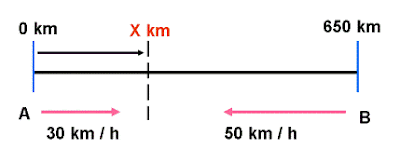
If 2 cars travelling at the speed of 30 km/h and 50 km/h meet at a distance X km away from the starting point of A, what is the time they will meet if they start off at the same time? The distance between them is 650 km apart.
Quick way to solve: T = 650 / (30 + 50) = 650 / 80 = 8.125 hrs (from start time).
From first principle:
Let the distance they meet be X km (from A point).
Since the time they meet is the same from A and B starting points,
X / 30 = (650 - X) / 50 ==> To find the value of X
(X / 30) + (X /50) = 650 /50 = 13
(50X + 30X) / 1500 = 13
80X = 1500 times 13 = 19500 ===> X = 19500 / 80 = 240.375 km
Time taken (T) for them to meet = X / 30 = 8.125 hrs (from start time).
Look here:
T = 19500/ (30 x80) hrs or
T = (19500/30) / 80 = 650 / 80 hrs
The "650" above (in bold) isn't it equal to the distance apart between the 2 cars?
The "80" above (in bold) isn't it equal to the total sum of the 2 speeds?
The working from first principle produces the SAME answer as the quick method!
But the major difference is that the solution from the Quick way has no long-lasting impact on learning as compared to the latter technique, which bank on understanding of principles of speed, time and distance.
Therefore, which way do you prefer (for longer retention of knowledge)?
:)
The question asked about the time taken when two persons or cars travelling at different speed and opposite direction meet each other.
A quick way to solve this question for its time is to apply the below:
Time taken = Total distance between the two objects / Total sum of the two speeds
However, what if we forgot this so-called formula?
As Albert Einstein once said "Education is what is left after all else is forgotten".
This is very true in learning, especially for maths.
If you forgot the formula to a question and without understanding its concepts and principles, do you think you can solve that question?
Yes, only by accident, if you are lucky.
Understanding the principles is very important as it enables you to solve any question starting from basic if all else has been "returned to the teacher".
Let us look at an example.

If 2 cars travelling at the speed of 30 km/h and 50 km/h meet at a distance X km away from the starting point of A, what is the time they will meet if they start off at the same time? The distance between them is 650 km apart.
Quick way to solve: T = 650 / (30 + 50) = 650 / 80 = 8.125 hrs (from start time).
From first principle:
Let the distance they meet be X km (from A point).
Since the time they meet is the same from A and B starting points,
X / 30 = (650 - X) / 50 ==> To find the value of X
(X / 30) + (X /50) = 650 /50 = 13
(50X + 30X) / 1500 = 13
80X = 1500 times 13 = 19500 ===> X = 19500 / 80 = 240.375 km
Time taken (T) for them to meet = X / 30 = 8.125 hrs (from start time).
Look here:
T = 19500/ (30 x80) hrs or
T = (19500/30) / 80 = 650 / 80 hrs
The "650" above (in bold) isn't it equal to the distance apart between the 2 cars?
The "80" above (in bold) isn't it equal to the total sum of the 2 speeds?
The working from first principle produces the SAME answer as the quick method!
But the major difference is that the solution from the Quick way has no long-lasting impact on learning as compared to the latter technique, which bank on understanding of principles of speed, time and distance.
Therefore, which way do you prefer (for longer retention of knowledge)?
:)
Subscribe to:
Posts (Atom)
+copy.jpg)


 Posts
Posts


