.
Maths expression may at times look challenging, but a bit of a thought may make it otherwise.
Logarithm is always an exciting topics to new learners.
With the "log" coming into the maths expression, one will be confused.
Definitely!
But do rest assure, as the tip below shows.
Maths Tip
eln y = y
Proving this:
"Natural log" both sides will give ln eln y = ln y
Applying the law that ln an = n ln a, and that ln e = 1, you will notice that the above mathematical expressions are true and equal.
NOTE:
This tip applies to "log" too.
10log y = y
Hope this helps.
:-)
Sunday, 13 June 2010


Wednesday, 2 June 2010
Model versus Variable Technique
'
In using Model method of solving maths question, we are using visual blocks to scope our thinking. This is followed by analysis through the models.
Models become a link to our thinking process.
The demerit is when we did not create the Model properly, or miss out some details that cause the model to be represented wrongly.
The merit is that it can be simple and straight forward when drawn properly. It reflects outright the relationship between many unknowns.
Less workings is thus needed, as visual que sets in.
For algebraic variable technique, the unknowns are pre-defined and booked as "letters". A space, mentally, has been reserved for the answer.
The working is just simply to accept that the answer is already there but only not numerical. Following through the working steps will ultimately reveal the letter of its numerical data which is what we want.
Variable as letter is good in the sense that we need less analysis, but just mechanically following the rules and steps leading to the final step, of course with some logic and mathematical strategy.
Each has its own advantages and weakness. It is up to us to make use of them in the correct way.
Experience is the only way to overcome the proper selection of which technique.
Thus practice to gain experience in maths is one good way to master maths.
Skiving is a no-no.
Through practice, you will sooner or later find that maths is interesting.
:-)
In using Model method of solving maths question, we are using visual blocks to scope our thinking. This is followed by analysis through the models.
Models become a link to our thinking process.
The demerit is when we did not create the Model properly, or miss out some details that cause the model to be represented wrongly.
The merit is that it can be simple and straight forward when drawn properly. It reflects outright the relationship between many unknowns.
Less workings is thus needed, as visual que sets in.
For algebraic variable technique, the unknowns are pre-defined and booked as "letters". A space, mentally, has been reserved for the answer.
The working is just simply to accept that the answer is already there but only not numerical. Following through the working steps will ultimately reveal the letter of its numerical data which is what we want.
Variable as letter is good in the sense that we need less analysis, but just mechanically following the rules and steps leading to the final step, of course with some logic and mathematical strategy.
Each has its own advantages and weakness. It is up to us to make use of them in the correct way.
Experience is the only way to overcome the proper selection of which technique.
Thus practice to gain experience in maths is one good way to master maths.
Skiving is a no-no.
Through practice, you will sooner or later find that maths is interesting.
:-)
Thursday, 27 May 2010
Purpose of Variables in Algebra
'
Unknowns are literally unknowns.
In maths, these unknowns are a cuause formaths anxiety.
When you are in unfamiliar territory, you will naturally be uncomfortable and unease.
This is the same feelingwhen dealing with unknowns in maths.
Algebra came to the rescue for this problems.
Here, you will find unknowns named as "variables".
They served as "parking lots" for the final answers or unknowns.
In this algebra, you replace the variables for final numbers and work with them as though you already know them.
You simply go through the motion of solving the question with any given condition and numbers / data.
Upon finally reaching the last step, the numerical answers for the problem will be revealed.
This is the power of the variables in algebra.
Just simply work along, and not be fearful of the unknowns.
The steps will align you to the final answers.
Cheers!
Maths is interesting!
.
Unknowns are literally unknowns.
In maths, these unknowns are a cuause formaths anxiety.
When you are in unfamiliar territory, you will naturally be uncomfortable and unease.
This is the same feelingwhen dealing with unknowns in maths.
Algebra came to the rescue for this problems.
Here, you will find unknowns named as "variables".
They served as "parking lots" for the final answers or unknowns.
In this algebra, you replace the variables for final numbers and work with them as though you already know them.
You simply go through the motion of solving the question with any given condition and numbers / data.
Upon finally reaching the last step, the numerical answers for the problem will be revealed.
This is the power of the variables in algebra.
Just simply work along, and not be fearful of the unknowns.
The steps will align you to the final answers.
Cheers!
Maths is interesting!
.
Saturday, 24 April 2010
A Mathematical Waterfall
'
Mathematics equation can be fun.
It is not only used as a problem-solving tool, it can be used to create visual image simulating scene.
By trying a few equations, anyone with patience and basic maths knowledge can do it.
Simply create an expression or equation in a graph and tweet it to form any image.
Here you will see an image formed up to look like a waterfall.
Enjoy yourself.
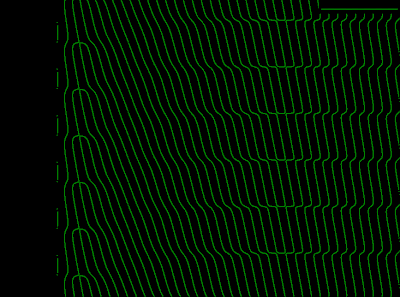
This was done with both logarithm and trigonometry functions.
:-)
Mathematics equation can be fun.
It is not only used as a problem-solving tool, it can be used to create visual image simulating scene.
By trying a few equations, anyone with patience and basic maths knowledge can do it.
Simply create an expression or equation in a graph and tweet it to form any image.
Here you will see an image formed up to look like a waterfall.
Enjoy yourself.
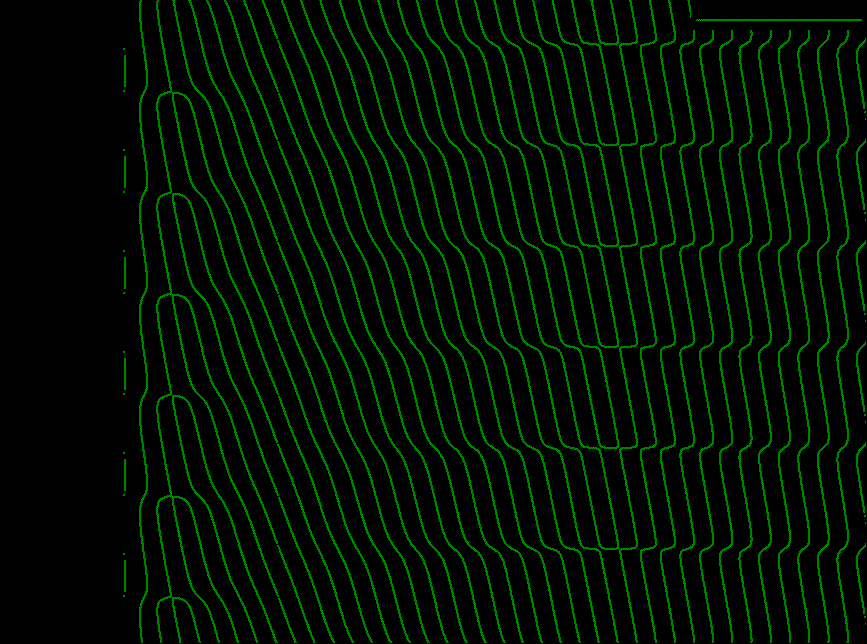
This was done with both logarithm and trigonometry functions.
:-)
Wednesday, 14 April 2010
Maths Symbol in Our Applications
.
There are many symbols in maths.
To learn and understand maths, we need to know the meaning of the symbols.
This is very much like talking to a foreigner. Without understanding each other's language, no communication can be carried out (other than the international body language!)
Hence, knowing the usage of the symbols in a mathematical expression helps.
But is it really so?
Partially.
Why do I say that?
Yes, you may know the symbol while doing maths, but if the same symbol is used elsewhere, do you still understand?
One example is:
y = x + 1
This means x is added by one and their total is represented by the variable "y".
This is for the maths operator "+".
But what about the expression x++ ?
This looks odd, isn't it?
To the maths learner, this may be a typo error, or something is missing.
"x++" is actually commonly used in C programming.
What it means is x = x + 1.
It is a short-cut way of writing the addition of x and replacing it by the same variable "x".
Thus this example showed the use of "+" in another application.
It is still maths in some sense, but written in another form.
Maths is therefore always around us. It is a matter of us applying them and understanding them.
Only by learning their "language", can we communicate with them.
Interesting? I bet you agree!
Other applications can be " += ", " :-) " and " x>>4 ".
Can you find their meaning?
:D
There are many symbols in maths.
To learn and understand maths, we need to know the meaning of the symbols.
This is very much like talking to a foreigner. Without understanding each other's language, no communication can be carried out (other than the international body language!)
Hence, knowing the usage of the symbols in a mathematical expression helps.
But is it really so?
Partially.
Why do I say that?
Yes, you may know the symbol while doing maths, but if the same symbol is used elsewhere, do you still understand?
One example is:
y = x + 1
This means x is added by one and their total is represented by the variable "y".
This is for the maths operator "+".
But what about the expression x++ ?
This looks odd, isn't it?
To the maths learner, this may be a typo error, or something is missing.
"x++" is actually commonly used in C programming.
What it means is x = x + 1.
It is a short-cut way of writing the addition of x and replacing it by the same variable "x".
Thus this example showed the use of "+" in another application.
It is still maths in some sense, but written in another form.
Maths is therefore always around us. It is a matter of us applying them and understanding them.
Only by learning their "language", can we communicate with them.
Interesting? I bet you agree!
Other applications can be " += ", " :-) " and " x>>4 ".
Can you find their meaning?
:D
Saturday, 10 April 2010
Number of Answers | Common mistake
Maths can be tricky when you are not careful.
This is not to frighten you, though.
This post is just to remind you of the wonderful aspect of maths in covering all areas.
Below is an example of what I meant.
Let's take the quadratic eqaution solving as a starting point
x2 = 5x
x = 5x / x = 5 (Answer)
At first, this looks pretty fine. The answer, when substituted back, produces match of equation.
But this is actually not complete.
Those doing quadratic equation will know 2nd order (x2) equation evaluates to 2 answsers.
The answers may be the same though.
Now, if we approach it using another method, let's see the different.
x2 - 5x = 0
==> x (x - 5) = 0 , after factorising
==> x = 0 and (x - 5) = 0
==> x = 0 and x = 5
There are two answers now.
We had the x = 5 initially, but what about this new x = 0.
We have missed out on the x = 0 with the first mehtod. It looks OK then.
What happen?
It may be due to lack of experience handling this form of maths question.
The concept in solving quadratic equation is actually not limited to second order.
The hidden message is depending on the order, the number of answers will follow suit.
What I meant is :
2nd order gives 2 answers,
3rd order gives 3 answers,
4th order gives 4 answers, etc.
It is this verry message that maths learner should capture. Otherwise you will be tricked to give only one answer which leads you to "mistakes" of being incomplete.
I agree that this is tricky, but within reasonable argument.
If a student practice hard (and smart), he will not fall prey to this type of simple math problem.
Do not get con again.
Enjoy maths. It's fun and interesting.
:D
This is not to frighten you, though.
This post is just to remind you of the wonderful aspect of maths in covering all areas.
Below is an example of what I meant.
Let's take the quadratic eqaution solving as a starting point
x2 = 5x
x = 5x / x = 5 (Answer)
At first, this looks pretty fine. The answer, when substituted back, produces match of equation.
But this is actually not complete.
Those doing quadratic equation will know 2nd order (x
The answers may be the same though.
Now, if we approach it using another method, let's see the different.
x2 - 5x = 0
==> x (x - 5) = 0 , after factorising
==> x = 0 and (x - 5) = 0
==> x = 0 and x = 5
There are two answers now.
We had the x = 5 initially, but what about this new x = 0.
We have missed out on the x = 0 with the first mehtod. It looks OK then.
What happen?
It may be due to lack of experience handling this form of maths question.
The concept in solving quadratic equation is actually not limited to second order.
The hidden message is depending on the order, the number of answers will follow suit.
What I meant is :
2nd order gives 2 answers,
3rd order gives 3 answers,
4th order gives 4 answers, etc.
It is this verry message that maths learner should capture. Otherwise you will be tricked to give only one answer which leads you to "mistakes" of being incomplete.
I agree that this is tricky, but within reasonable argument.
If a student practice hard (and smart), he will not fall prey to this type of simple math problem.
Do not get con again.
Enjoy maths. It's fun and interesting.
:D
Subscribe to:
Posts (Atom)
+copy.jpg)


 Posts
Posts


