Maths is one of the crucial and necessary subject we have to learn in school. Everyone has to go through it.
Some like it, while some fear it. Have you wonder why?
Actually this fear is not only towards maths. The underlying reasons applies to anything we do.
It could be literature, Chinese language, dancing, or even driving and riding a bicycle.
What we have to do to reduce maths anxiety is to know why the fear occurs.
One of the issue links to the confidence level. This affects the comfort level. With things we are not comfortable, we tend to avoid. Avoiding make us do less of the subject.
We thus lack practices.
Learning maths involves 2 parts, namely:-
1) Procedural skills, and
2) Conceptual understanding.
Different stages / levels in the learning journey entails different focus of these 2 stages.
To have a better understanding, you may go to this maths site to read more.
It is rather enlightening.
Learning anything needs a plan. (Procedure ==> Conceptual ==> Application)
If fear is the barrier, and causes obtrusion to learning, seek out why.
We grow as a result of this process.
Maths is one target in life that we can use to challenge yourself, besides the tools and techniques picked up to solve mathematical problems.
It involves character development as well, if you border to analyse the learning process.
Finally, to motive any maths learners,
just know that "Maths Is Interesting!".
You will then like maths, and anything you set forth to master.
Cheers! :-D.
Showing posts with label teaching maths. Show all posts
Showing posts with label teaching maths. Show all posts
Friday, 17 February 2012


Sunday, 27 September 2009
Maths Symbols versus Real life Applications| Teaching style
'
Is maths interesting and is easy to learn or teach?
There are always argument over how to really capture maths students' attention and make them understand the principles and concepts in maths.
One school of thought is to approach the real life case studies.
Here actual applications are taught to make aware the usefulness of maths.
Problem-based case studies are planned into the curriculum to allow the learners to learn maths.
Another approach that is conventional is to pump in concepts and techniques using symbols and hard formulae.
Here students learn maths consists of symbols and their true meaning in the workings.
No real life indication is mentioned or just skimmed through. The focus is purely the use of maths tools to solve questions.
What are the advantages and disadvantages?
1) For real life approach, there are chances that the learners may couple their maths learning to only that particular application.
If train speed is mentioned or used, the students may only understand that the maths tools apply to train and not areoplane. The scope of aplication is a factor and serve to be a disadvantage.
The advantage is that the learners can relate to the usefulness of maths and will pay more attention and feel more fulfilled.
2) The advantage of pure symbolic approach in the conventional teaching method is that scope of the maths tools are wide. No tying down of the maths techniques to any specific area enables fredom of use.
The disadvantage, of course, is that the students may take a longer time to see that actual useulness of the maths tools and principles.
So what is the best method to learn maths?
I suppose the answer lies with the type of students and the topics to be taught.
No one way is best.
It has to be customised to suit the students or majority of them
Flexibility is thus the best methods and getting a good maths teacher who can read the minds of the students is the better choice.
If the classroom teacher is not up to expectation or has some constraints, it will be good to look for private tutors to brush up the maths learning. Note, classroom teaching does not cater for individual needs and this is a fact.
Happy maths learning.
Maths is interesting!
Don't forget it.
:-)
Saturday, 18 July 2009
Maths Is Just Another Language
'
"I don't understand maths!"
Does this sound familiar?
This statement is not only from young learners, but from adults too.
What actually happened?
Maths is interestingly unique. This is so because it represents a different way of presenting messages.
Maths is a "short form" of written langauge.
It is like the short-hand symbols that many people use to note down minutes of meeting.
What is 1 + 3 = 4?
In the common English language, it simply means "one added to three equals four".
Nothing different.
However, visually, the maths equation is encoded with symbols.
What is this "+" and "="?
If you do not understand the meaning and usage of these two symbols, then you are lost.
Thetefore, learning and understanding maths is knowing the unique symbols presenting the "message".
How about 3y = 24. What is "y"?
The question is finding "y" given the relationship above.
The equation in English means "When we multiply "y" by 3, it gives 24".
The solution, thus, it English, is: If I divide this 24 by 3, I will get the answer that is 24/3 = 8.
In maths concept: 3y = 24 ===> y = 24/3 = 8.
It is the interpretation of the maths symbol and its communication with the learners that is key to doing maths.
It is not difficult if you understand the language of maths.
Maths is interesting!
:D
Monday, 8 December 2008
Correct Method over Correct Answer
In math, you do not go for correct answer.
Yes, correct answer motivates. It is the ultimate goal for any math learner.
But is that all to math?
Math calls for more than that.
Read this story before moving on......
You have to ensure that the correct answer is gotten with the correct method and concept or principles.
Many a times, students can obtain correct answers to a math question, if it is not properly though over by the teacher.
If the teacher did not do a scrutiny over the working, the answer may be passed off as correct.
This is disaster.
If the student did not master the concept properly, this sort of happening will also results in learning disaster.
Therefore, seek to learn the correct technique or math method instead of aiming for the answer.
It is better to get wrong answer with the correct method than getting correct answer with wrong technique.
This makes learning math interesting!
.
Monday, 18 August 2008
Ways To Improve Logical Learning Part Of Maths
In learning of maths, as with learning of other subjects, we need to understand our learning styles. The styles are namely, visual, auditory and kinesthetic.
Each of us has one particular dominant style. Knowing which one will thus serve us good. However, the learning style itself is still not enough, we need to also know the types of intelligence we possess.
The learning styles are used to gather information and ideas, through the senses, for the brain. But how do we process the information captured afterwards depends much on the intelligences that we also have.
In maths learning, what we need is the logical / mathematical intelligence.
This lets us do all sort of computations and comparisons that maths requires.
An example is the conversion of an expression in logarithmic form to its index form (and vice versa).
logaY = X <==> aX = Y
Though, this conversion seems simple enough, it is found that many students still have difficulties in converting the above. Do they lack this logical intelligence?
The answer is "maybe" and "maybe not".
They may have possess this logical intelligence, but has not yet enhanced it.
One way to offset this weakness in the logical comparison part of intelligence is to introduce the visual intelligence into maths learning.
What is this visual intelligence?
This is the "appearance" aspect of information processing. Here, colour, shapes, and the likes are linked up to the information.
Why introduce the visual intelligence?
The main reason is to bridge up the right and left brain, a theory that is now well-known and practiced throughout the learning and teaching communities.
Now, let's see how we can solve the logarithmic and index conversion through the use of the visual intelligence.

The examples above showed two very interesting ways to enhance the learning. :)
The first one is to replace and "beautify" the symbols with pictures or graphics to arouse retention ability.
The second one is to make use of colours to strengthen the symbols and their placements.
By seeing pictures and colours, although they are no way close to any maths topics, the learning of maths is greatly improved especially for the logical comparison portion.
Therefore, if possible, introduce as many "visuals" into maths as you can. They will make maths learning a totally new experience. Take care of intelligences and intelligences will take care of you.
Inspired ?
:=)
Each of us has one particular dominant style. Knowing which one will thus serve us good. However, the learning style itself is still not enough, we need to also know the types of intelligence we possess.
The learning styles are used to gather information and ideas, through the senses, for the brain. But how do we process the information captured afterwards depends much on the intelligences that we also have.
In maths learning, what we need is the logical / mathematical intelligence.
This lets us do all sort of computations and comparisons that maths requires.
An example is the conversion of an expression in logarithmic form to its index form (and vice versa).
logaY = X <==> aX = Y
Though, this conversion seems simple enough, it is found that many students still have difficulties in converting the above. Do they lack this logical intelligence?
The answer is "maybe" and "maybe not".
They may have possess this logical intelligence, but has not yet enhanced it.
One way to offset this weakness in the logical comparison part of intelligence is to introduce the visual intelligence into maths learning.
What is this visual intelligence?
This is the "appearance" aspect of information processing. Here, colour, shapes, and the likes are linked up to the information.
Why introduce the visual intelligence?
The main reason is to bridge up the right and left brain, a theory that is now well-known and practiced throughout the learning and teaching communities.
Now, let's see how we can solve the logarithmic and index conversion through the use of the visual intelligence.
The examples above showed two very interesting ways to enhance the learning. :)
The first one is to replace and "beautify" the symbols with pictures or graphics to arouse retention ability.
The second one is to make use of colours to strengthen the symbols and their placements.
By seeing pictures and colours, although they are no way close to any maths topics, the learning of maths is greatly improved especially for the logical comparison portion.
Therefore, if possible, introduce as many "visuals" into maths as you can. They will make maths learning a totally new experience. Take care of intelligences and intelligences will take care of you.
Inspired ?
:=)
Analysis of Maths Error
Making mistakes during maths learning is a common step to mastery of its concept.
This is possible, provided the learners pick up the error made and understand them through detailed analysis.
I came across an error that puzzled me for quite some time.
The error made: Inverting y = 2x + (1/x) became 1/y = (1/2x) - x
What actually happen in the thinking during the math manipulation?
Understanding the thinking will definitely help in resolving the issue and prevent further mistakes made.
Here, I believe the student:
- confused "flipping" cards with the basic concept of maths (flipping the left y does not equate to individually flipping the right mathematical terms)
- confused the property of indices ( 1/a = a-1) with this operation, resulting in the last term having a shocking "-" appearing after the inversion of denominator to numerator placement.
- lack practices to enhance the algebraic manipulation during the learning phase. Knowledge is not retained.
Analysing maths error is not an easy task if done alone, and without guidance.
The thinking part is an abstract art of the mind. If there is no communication to reveal the mental procedure in solving the math question, a skilled guess has to be made especially by those teaching maths.
If guidance is not available, textbook will be the next best alternative to answer for the mistake encountered. Go back to basic to dig out more understanding.
The approach is to question and question till satisfied. It will cover most aspect of the learning objectives.
However, do note that identifying and analysing maths error is a great learning process.
It serves to filter out current bad learning habits and replaces the gap with proper systematic steps. This is of much importance especially in maths where every steps count.
Therefore, do enjoy "debugging" your maths error. It is fun and not meaningless!
Errors do tell many stories. Just be friendly to them.
:-)
Sunday, 17 August 2008
How To Study Math Wisely
There are many studying techniques a math student can use. The technique, however, has to suit his character and learning style. Some may be the "slow and steady" type, and some are the "fast and direct-on" method.
But, whichever method one selects and sticks with, an important learning concept is reflected in the Pareto Ratio.
What is this all-important "Pareto Ratio" about?
Pareto ratio is simply a 80 /20 ratio. Though it is simple, its impact to many things are fantastic, and is the deciding element that constitutes wise and effective learning.
What do I mean?
Pareto ratio actually allows us to understand that 80% of the work are done by only 20% of the people.
And 80% of knowledge can be mastered from 20% of the learning material!
This is good news, isn't it?
Yes, it is true. But where is this 20% of the key learning material?
In math textbooks, this important 20% normally lies at the beginning of a new topic or chapter. It consists of the principles and concepts portion within the complete chapter.
Here, knowledge is "told". After this portion, worked examples follow up to demonstrate the application of the concepts and principles of the new topic. At the end of this worked examples and explanation, comes the exercise part for student to practice.
Take a look at any math book on hand. The flow is almost the same with slight deviation to make it outstanding.
The worked examples and exercises constitute the 80% of the learning material that only serves to enhance knowledge. They are important though and should not be ignored!
The message here is that to really master math, focus should be placed at the front 20% of the notes. Understand deeply the concepts and principles within it, and then move on to apply the learned knowledge to test for comprehension of the materials. This is learning math wisely.
Some math learner do otherwise by jumping directly (and impatiently) into the exercise even before a decent level of understanding sets in. This is academic disaster! Avoid it to save time and frustration.
Thus, to learn wise, aim for the 20% and you are effective for the other 80%.
Wonderful right? :)
.
Mathematics Graphics Helps In Better Understanding
Mathematics is a subject that translates in a language that is unique.
Though the questions and explanations may come in the normal English or any equivalent first language, mathematics still consists of symbols, abbreviations, variables and mathematical operators, besides the numerous expressions or equations.
Learning and teaching mathematics, thus, become a chore for those "newbies" as well as those who detest the subject.
Graphics to represent mathematics meaning is therefore a welcome move for them. Although not all mathematical expression can be presented in graphics, it is a better option in term of knowledge retention.
Take an example of solving the simultaneous equations.
Example 1:
Solve y = 2x - 4 and y = -x + 6
To the mathematics learners, this may seem daunting even after explanation. They may not be able to visualise mentally what really is these 2 equations doing, not to say, solving them.
However, if the question is shown in graphics or converted likewise, the understanding will immediately be clear.
Compare the above "worded" question with the "graphical" question shown below.
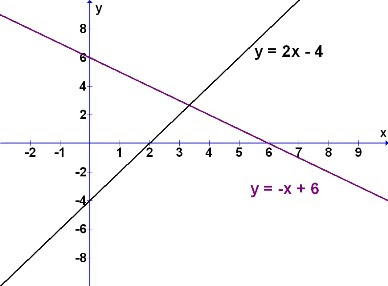
From the graphical interpretation of the mathematical question, it is easier then for the students to understand what is needed. The equations are here clearly shown as lines that intersect at a common point. See the advantage now?
Let's see another example.
Example 2:
The all-famous Pythagorean Theorem is presented as x2 + y2 = z2.
But this is a simple mathematical expression or formula, and that's all (to them).
What actually does it means? Besides pure memorising, what else?
If this Theorem is presented in the graphical form (below) , you will see the difference.
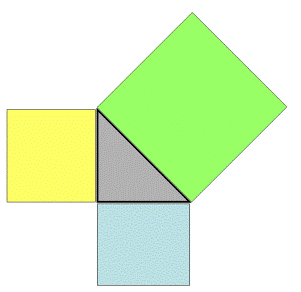
Here the idea that the "squaring" of the sides are related through the Theorem will be easily accepted. The message of the Pythagorean Theorem as areas of various squares will be captured and locked mentally for understanding and retention with ease.
Why is graphical form a better technique of learning and teaching?
This has to do with our brain. It is well known that our right hemisphere of the brain is for image, and the left hemisphere is for logical matters including studying for mathematics.
This graphical learning and teaching, therefore, goes in line with well-known and accepted method of linking right and left brain for better comprehension.
For mathematics learners, it is hence a merit to be able to convert most mathematical knowledge to images, if possible (although it is understandable that not all is possible).
For mathematics teachers, use graphics if possible to save your breath.
Happy imaging !
.
Though the questions and explanations may come in the normal English or any equivalent first language, mathematics still consists of symbols, abbreviations, variables and mathematical operators, besides the numerous expressions or equations.
Learning and teaching mathematics, thus, become a chore for those "newbies" as well as those who detest the subject.
Graphics to represent mathematics meaning is therefore a welcome move for them. Although not all mathematical expression can be presented in graphics, it is a better option in term of knowledge retention.
Take an example of solving the simultaneous equations.
Example 1:
Solve y = 2x - 4 and y = -x + 6
To the mathematics learners, this may seem daunting even after explanation. They may not be able to visualise mentally what really is these 2 equations doing, not to say, solving them.
However, if the question is shown in graphics or converted likewise, the understanding will immediately be clear.
Compare the above "worded" question with the "graphical" question shown below.

From the graphical interpretation of the mathematical question, it is easier then for the students to understand what is needed. The equations are here clearly shown as lines that intersect at a common point. See the advantage now?
Let's see another example.
Example 2:
The all-famous Pythagorean Theorem is presented as x2 + y2 = z2.
But this is a simple mathematical expression or formula, and that's all (to them).
What actually does it means? Besides pure memorising, what else?
If this Theorem is presented in the graphical form (below) , you will see the difference.

Here the idea that the "squaring" of the sides are related through the Theorem will be easily accepted. The message of the Pythagorean Theorem as areas of various squares will be captured and locked mentally for understanding and retention with ease.
Why is graphical form a better technique of learning and teaching?
This has to do with our brain. It is well known that our right hemisphere of the brain is for image, and the left hemisphere is for logical matters including studying for mathematics.
This graphical learning and teaching, therefore, goes in line with well-known and accepted method of linking right and left brain for better comprehension.
For mathematics learners, it is hence a merit to be able to convert most mathematical knowledge to images, if possible (although it is understandable that not all is possible).
For mathematics teachers, use graphics if possible to save your breath.
Happy imaging !
.
Friday, 15 August 2008
Smell of Number Inspires Maths Learning
This is a real story about a young girl that I have come across while teaching her maths. Inspiring ...... And something new that never cross my mind till then.
Visually mathematics consists of numbers, symbols and equations. Teaching mathematics needs patience as well as learning it. However, I recently met a case that provides a twist to my mathematics teaching method.
The special case involved a young girl doing assignment on simple multiplication. Her head was real down, close to the question paper. I observed her sitting posture for some time and noticed also that her progress was not good enough. She managed to do 2 questions while her classmates, on average, has gone on to the 4th question.
Getting worried, I moved towards her. I noticed then that her nose was almost touching the numbers. A mental flash gave me the cue to ask her a question.
"What's the smell of the numbers?"
"Your nose is close to them." I said.
With a stunning look, she replied "Horrible smell!"
"Well, change the smell to something you like." This is the cutting suggestion I proposed.
I moved on to supervise the rest of the students.
After a round of checking the class and back to the same girl, I was shocked that she had completed 3 additional questions in that short period that I left her after making the "smelling" statement.
"What's now the smell of numbers?" I ventured to ask the amazing girl.
"Roses!" she replied.
Never did I expect that virtual smell of numbers can motivate the girl to do her mathematics. This event gave a renewed angle for me to approach mathematics teaching. Interesting!
.
Thursday, 14 August 2008
Is Maths A Teachable Subject?
Maths education is basically divided into two parts or levels. The fundamental and the advance parts.
In the fundamental part of maths education, learners pick up the principles or concepts of the maths and the "tips" in solving some standard maths questions.
Here steps are shown to the learners and is the part that is teachable. The details on using a particular method, formula, or approach are taught for the purpose of generating the learner's knowledge and to increase his maths mental bank.
The learners may be drilled at this stage of the learning process to master a certain maths method. No deviation from the taught topic is allowed in this part as monitoring of the learner's progress may be disrupted. Here, therefore, maths is teachable, for a targeted objective.
After building up an arsenal of maths knowledge and skills, the learners are ready for advance topics. Is maths then teachable?
In this advance level of maths education, the learners are left on their own to find solution to maths challenge given. They will have to base on their judgement to select the appropriate maths technique to analyse and solve the question. A lot will have to come from their past experiences at this stage.
Different methods will require different formula and approach. Everyone will supposedly come out with different steps in solving the maths problem although the final answer will be the same (if correct).
In this advance part of maths learning, the subject will be unteachable. Only guidance can be provided as too many approaches are possible. A single problem can be solved by many possible ways.
Upon reaching advance level in maths education, it reflects the capability of a person in handling problems. Problem-solving in maths is equivalent to being thrown into the wide ocean and having to tackle the issue at hand with relevant skill and knowledge.
Those person who showed their ability to handle maths well, are normally considered to be fast learner or at least have the foundation to branch into more complex field of studies. One example is flight pilot training and engineering studies.
In conclusion, whether is maths a teachable subject depends on which stage of the maths education is the learners at (likewise for the maths teachers). The understanding, from the students, of the teaching style change at different level is important as any "spoon-feeding" at the advance level is detrimental to the mental development since the key application part in problem-solving is not fully utilised.
Therefore to succeed in maths, one has to finally seek self- independence in solving problem to reap full value out of maths education.
Math builds a man! It strengthens his character and his determination.
:-)
.
Tuesday, 12 August 2008
Pleasure From Math Teaching And Learning
One of the most emotional element in a human is pleasure. If any thing is driven by pleasure, then it reduces resistance towards it.
With this knowledge, teaching and learning math can be made less strenuous with the introduction of pleasure in its process.
Fun math with exciting interactive activities can be included to complement conventional classroom practices.
In order to allow pleasant learning, students can be exposed to the pleasure involved with math.
One example to let them see the wonders of numerous amazing math patterns, like the Pascal Triangle sequence.
The Golden Ratio is another example that will excite them.
Magic math also can be used to trigger their curious mind.
Try mental math. Show them the simplicity to perform math mentally which they think is only possible through the calculator. How about graphical plots? Beautiful pictures can be generated.
For more ideas, the internet is good place to source for information.
Let the students have the pleasure to know and understand the "why" of something.
The feeling of pleasure is the catch to hold them interested.
Therefore one of the key element to capture students' attention is to put in pleasure as much as possible into the math lesson.
This, too, will make math teaching fun.
Do you agree?
:-)
.
Math Blogging - A New Perspective
For this post, allow me to deviate from the technical aspect of the subject.
I would like to write (or talk) about the thinking after having blogged about maths.
This is a totally new thing and a new perspective for me to give information regarding maths in a blog. I wonder what is the effectiveness in translating these information.
The setting I have put forth is a relaxing and informal approach to entice math learners to like math.
Learning math can be stressful in a class-room environment with strict discipline and rigid time frame. But through presentation using blogging, you can go through the short material repeatedly till satisfied.
The advantage is that you can even post comments and gather feedback.
Math blogs gives a totally different perspective to learning style.
This is what I am aiming for.
Relax if you haven't. Maths is after all a subject that wishes to train a curious mind. It is here not to stress but to be enjoyed! It is fun and exciting!
:-)
Monday, 11 August 2008
Creative Approach To Maths Question
Maths is interesting and exciting. You can also be creative through being able to solve or answer challenging maths questions. The approach to solving the problems decides how effective you can be trained for creativity.
Below an example is explained.
Determine whether the expression 62x - 22x can be divided by 4.
You can solve this maths challenge through various approaches.
One approach is to substitute the variable "x" in the expression by an ambiguous integer. The number obtained, after the substitution, can be easily determined by applying the divisibility by 4 rule. Click on this link to view the divisibility by 4 rule.
However, this approach is mathematically not elegant. It suffices, though, to meet the question objective.
A better approach that looks more mathematically professional, is the application of factorisation to determine the possibility of divisibility by 4.
This approach requires prior knowledge of the factorisation method to the given maths problem.
Factorisation method to the general expression a k - b k :
a k - b k = (a - b)(ak-1 + ak-2 b + ... + abk-2 + bk-1)
Therefore by re-writing 62x - 22x = (6 - 2) ( ........), it becomes very obvious that the given challenge can be divide by 4 since the first written factor of the expression is (6 - 2) = 4!
The message here is that there are various ways to achieve the objective of the maths question. It is a matter of which method is creative or interesting and involves mathematically challenging steps. The approach can be direct and less conceptual or conceptually involved with application of maths theorems. Both are, within their own definition, creative in nature.
A new mindset looking at maths as it is, can change this exciting subject to a life-aspiring adventure with challenges that buils up a person's character.
Wonderful maths .....
:-)
Ways To Instill Creativity In Maths Teaching
As the saying goes that Teacher are the best role model for students, if the teacher has no creativity in her teaching, will the students follow suit?
There are remarks that maths gives results that are fixed or standard. It is either correct or incorrect answers. By doing maths, it clamps down creativity. It differs from subjects like the Arts or Literature, where flexibility of thoughts are encouraged.
In a way, the remarks are true, but to a certain limit. It all depends on the teaching and objectives of the maths lesson.
To instill creativity, the process of the solution can be made to vary. Getting to the final outcome can be derived through application of different maths tools or techniques. This is possible if the maths problems given are not tied to a specific method. The answers can be open-ended in nature depending on the path the students take.
An example of an open-ended maths question is to ask "What are the numbers that can be formed given a set of 4 fives ?"
This question will stretch the students' mind and understanding of mathematical operation and giving many possible answers.
The answers can be:
5 + 5 + 5 + 5 = 20, or
5 x 5 x 5 x 5 = 625, or
5 x 5 + 5 + 5 = 35, and so on ......
This type of questioning opens up the scope and does not confine the answers to a fixed method. The students are free to express their solution as they wish but still applying basic mathematical operations. It helps creativity.
Another way is to create a problem and ask the students to solve the problem using any method or maths theorem they have learned. This is problem-solving questioning.
This method gives the students freedom to select a familiar method or enables them to combine various technique to solve the challenge.
In summary, maths does not necessary clamp down creativity. The questioning can be modified to make the solving flexible and requires the creative juice to get the answers which may be open-ended. It is not the actual answer in this type of creativity-generating maths questions that matters, but the steps in solving the questions or the procedures and tools needed that is the objectives.
Remarks: Do not bored the students, otherwise they will fear maths. Show to them that maths is interesting!
.
s Getting Correct Maths Answers Important?
In maths teaching and learning, the norm for a classroom-based tutorial is to get correct answers to achieve a high score. This is one way to gauge whether the teaching and learning has been effective. But it is not 100% true always. Why?
The students can copy another person's answer to get a better marks, if desperate. The students may have learned the lesson through rote-learning or memorising. Therefore getting correct answers to any maths questions is not the only way to judge outcomes in maths teaching or learning. The emphasis to the students is to ensure that they master the concepts and the "why" of a particular topics.
Through focusing on the solving steps, understanding of the topics can be revealed. Focusing on the end result may not show true understanding. Another way to access understanding is to do an oral questioning along the way when the students are doing the written work. Human errors may occur along the way during computation of numbers, for example, pressing the wrong button on a calculator, and thus getting a wrong answer. If we focus on the final result, it may do injustice to the learners when the steps and concepts are applied correctly.
Therefore, in short, emphasis on the thinking process rather than the final outcome, although it is still equally important at times.
.
Sunday, 10 August 2008
Simple Trick To Encourage Maths Practice
In maths teaching, worksheets are a necessary tools to enable students practice and apply their newly found knowledge. It serves to reflect the underlying level of understanding to both the teachers and learners. It shows whether the teaching is effective and whether the topics taught has been learned correctly.
In maths, symbols, variables, equations and expressions are aplenty. They tells many "stories". It is through these that ideas get across.
So what happens when they are not properly written?
What happens when even maths questions are poorly written?
Will the students be motivated to practice on them?
For good maths teaching, questions on the worksheets can preferably be written with a font size suitable for the topics. If there are many superscripts involved, it will be good to have bigger font size.
Example is Indices, where the placement of the "power" number is at a higher level. If this "power" number is too small, what happen when the students have to strain their eyes to encode this number?
Compare 2x with 2x. Which has a better chance to motivate or at least make maths practice pleasant?
If original maths worksheets is already small in font size, we can make a zoom-up copy of it and hand to the students. The students will be delighted!
This is an indirect way of clearing obstacles to the learning journey. A small and simple step mentioned above can set a positive direction to anyone learning maths.
Focus on the basic essential of teaching, and all else can start with a happy footing.
:-)
.
Saturday, 26 July 2008
Application of Maths to Swimming
How can maths be related to maths, you may wonder. Read on to find out.
Swimming is a common activity that many people does.
What is its relationship to maths?
The followings are some of its relationships:-
1) Speed of swim (measurement of distance and time)
2) Surface area of palm (area measurement of odd shape)
3) Kicking angle of the legs (trigonometry, angle)
4) Body profile - streamlining ( shape , geometry sector in maths)
5) Rhythm of the stroke (sequence, counting, pattern sector)
6) Breathing (volume of air required, space measurement)
7) Force of stroke (analysis sector, measurement)
8.) Friction of body to water (analysis sector)
The above are items we can discuss during maths lesson or during learning of maths with emphasis of practical application in real life.
This will make maths education more meaningful and enticing to learners. Use as many relationships to maths terms and concepts to bring in linkages so as to better retain the topics learned.
Hard facts are difficult to memorise.
Therefore, with bonding to real-life applications, retention of concepts can be more easily retained. Have fun with maths.
Maths is seemingly getting more interesting now, right?
Click here to have an overview of Sectors of Maths.
:-) Cheers!
.
Application of Relating Maths to Riding Bicycle
To appreciate maths, we need to relate or form real applications to aid maths learning or its understanding. We can apply maths concepts and its terms to any daily activities in the course of teaching or learning. Examples are easy to find since maths are everywhere.
One example can be simply riding a bicycle.
In this activity, many things relating to maths can be cited.
Let's see the relation.
To start off, riding and getting the bicycle to move forward steadily, we need the momentum and speed (this is measurement).
How to balance properly while riding ?
(This is related to the EQUAL operator in algebra, left side equals right side).
How far to ride on?
(This is distance measurement and unit term, metres or kilometres?, exponential expression).
Objects can be counted, example, lamp-posts that pass by along the way.
(This is counting and pattern recognition ability).
Braking force and how much to apply?
(This is analysis sector of maths).
Curve turning during cycling is another task to relate to maths.
(This is the geometry sector).
The parts of the bicycle can also be related to maths.
- Diameter of the wheel
- The angle of the seat
- The gear ratio of the pedal
- The strength of the metal support
- The weight of the bicycle
How long can the bicycle last?
(This is related to analysis sector, and probability study)
The above are some examples of citing maths term to actual real-world activity and item. Maths is not an isolated subject that is abstract from real-life.
With practice, we can quote many examples of maths relation to daily activities.
For more details on the numerous Sectors of Maths, view this link.
For another example of maths relation to real-life case, view here.
.
Application of Sectors of Maths (Case study)
Mathematics learning involves two aspects, namely, factual part and thinking part. The sectors within these 2 parts in maths education can be viewed at this link.
One case application is a camping trip outdoor. In this activity, we can see the applications of the various sectors of the maths in the tasks involved. It allows the learning of mathematics to be attached to real-life issues.
Let's start....
In preparation for the outdoor trip, the below tasks are involves:
Planning a camping trip includes inventory control, number of members going (number usage sector), what is used to carry the items (measurement sector), and the schedule of tasks (relating and analysing sectors).
Packing of the items into various bags and containers (volume measurement sector) comes next.
The journey (time measurement sector) to the camp site is another relation to maths that can be discussed and emphasised.
The location or direction to the camp site (geometry and measurement sectors) is related to trigonometry, angles, and distance measurement.
Selecting and setting up the camp site (analyzing, problem-solving sectors and number usage sector) involves getting the correct number of members to do various tasks, like pitching the tent (geometry sector - tent layout), and driving the wooden pegs to secure the tent (measurement sector - how deep in).
Cooking for meals involves calculating the individual amount (volume) of food and procedures (fractions, analysing, problem-solving, pattern and measurement sectors).
All the above tasks involve maths relation sector as well, because they are directly related to real-life practical issues.
From this case application of a simple coutdoor trip, we can see that the learning and teaching of maths can be factored into the numerous activities within. This makes future maths lessons and topics easy to accept as maths takes on a different platform with the acknowledgement that maths is everywhere in our daily life and can solve real-life problems.
Maths is reallllly interesting!
.
Sectors of Maths - Problem Solving (Thinking part)
Problem Solving in maths is the most important skill anyone would like to master. With this skill mastered, maths questions will be a breeze to solve.
They may not be easy themselves, but the process to solve these maths questions will not be difficult when the other sectors of maths are handled well. This problem solving sector comes after the Analyzing sector, which builds up skill in deciding the apprioprate approach to a given maths question.
Problem solving is not done by memorising all the facts and steps in solving maths problems. If it is so, then maths education losses its meaning.
Problem solving sector is aim at creating skill in solving problems using principle and facts related to the given problem. With this problem solving skill picked up through maths education, we will be ready to face any problem not even related to maths!
Problem solving ability involves exploring relationship between all the factual sectors (fractions, geometry, patterns, number usage, and measurement) and analyzing through the process to obtain a decent answer. This mathematical solving skill will be used to expand on other non-mathematical skill like language and presentation know-how.
What can be done to boost up Problem Solving skill in maths education?
Below are some of my suggestions:
1) Case studies on certain unworkable projects. Ask the learners to figure out the problems and come up with as many possible solutions to the problems.
2) Set a goal and allow the maths learners to determine the process to achieve the goal. (e.g. building a table with 2 uneven legs, with maths calculations to support solution)
Problem solving sector encompasses all the skills needed to handle maths quesions. It integrates both the thinking and factual part in maths education.
For children new to formal maths learning, the various factual maths sectors have to be mastered before they can proceed to the thinking part, which requires a certain amount of maturity and self-discipline.
To read other sectors related to this sectors and an overview, visit Sectors of Maths.
:-)
.
Subscribe to:
Posts (Atom)


 Posts


