In maths, we do come across topics on estimation.
This topics relate to our daily living very closely and is truly practical.
Example is when we go shopping and starts to count the expenses to be paid.
But mathematical estimation has one key concern.
To what extent or how accurate does one wish to?
There is no right or wrong to an answer when dealing with estimation. After all it is an ESTIMATED answer.
The basic requirement is thus to get as close to the true answer as possible.
Let's start with one simple example to demonstrate the concept.
Example:
y = 0.501 + square root(3.89)
What is y without using calculator ?
Answer 1:
y = 1 + square root (4)
y = 1 + 2 = 3
Answer 2:
y = 0.5 + square root (4)
y = 0.5 + 2 = 2.5
You can now see that both answers is close to the actual answer of 2.4733.
However, it is the gap or extent of the difference you wish for.
If possible, LOOK carefully at the numbers and give a best estimation closest to ability to compute the answer.
Here, from the above, you will notice the first term of 0.501 decides the outcome.
Estimate this 0.501 to what numeric value?
Think further and you will find that 0.501 to 1 will give you a bigger difference compared to 0.501 to 0.5.
If you can mentally handle 0.5 as the estimated value for computation, go for it since this should be closer to the final outcome.
Thus in conclusion, do look a bit closer to the numbers presented in your problem and simply do a brief calculation of the differences between estimated and raw data. Then you are one step closer to getting a good estimation.
Estimation, finally, boils down to how far you are to the actual answer. Nothing difficult.
Interesting? Any more suggestions?
.
Showing posts with label maths technique. Show all posts
Showing posts with label maths technique. Show all posts
Friday, 22 March 2013


Friday, 18 November 2011
Tips On Using Substitution
Maths entails the usage of our brain juice in solving problems. It is a good platform for stretching our imagination and creativity by using simple concepts learned to handle seemingly complex maths questions.
Let's look at a "complex" simultaneous equations maths problem, and its way of solving (suggested).
Question:
 ---- (A)
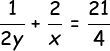 --- (B)
Solve for y and x.
How do you go about it?
Look scary, right?
But like what I said, looks can be deceiving. Use the brain to go around the issue!
Tips: The structure of the simultaneous equations looks similar to the conventional type.
(Conventional type:-
Ax + By = nn
Cx + Dy = kk )
So what we have to do can be to simply substitute by m, and
 by h (or any variable name).
What we thus convert to is:
 ---- (A)
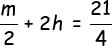 --- (B)
Will this simultaneous equations be more comfortable to solve?
Hence, a simple twist to the former mathematical questions can result in a totally familiar situations where we have solve many a times.
Thus, the technique and usefulness of substitution cannot be under-estimated.
It can be powerful at times to reveal a beautiful mathematical expression for user to resolve.
Maths Is Interesting!
Treasure our brain and our thinking.
:-)
Let's look at a "complex" simultaneous equations maths problem, and its way of solving (suggested).
Question:
Solve for y and x.
How do you go about it?
Look scary, right?
But like what I said, looks can be deceiving. Use the brain to go around the issue!
Tips: The structure of the simultaneous equations looks similar to the conventional type.
(Conventional type:-
Ax + By = nn
Cx + Dy = kk )
So what we have to do can be to simply substitute
What we thus convert to is:
Will this simultaneous equations be more comfortable to solve?
Hence, a simple twist to the former mathematical questions can result in a totally familiar situations where we have solve many a times.
Thus, the technique and usefulness of substitution cannot be under-estimated.
It can be powerful at times to reveal a beautiful mathematical expression for user to resolve.
Maths Is Interesting!
Treasure our brain and our thinking.
:-)
Sunday, 16 January 2011
Simultaneous Equations - Decimal Numbered
In the learning of maths, questions grow challenging as one progress upwards.
One such example is the solving of simultaneous equations.
The easy type:
Solve for x and y using elimination method.
4x + 3y = 10 ---- (1)
3x + 4y = 11 ---- (2)
For the above problem can be solved easily by selecting a coefficient to be commonised.
The post of elimination method is reference here for review.
But moving on (higher) with more challenging maths question ... we may get the below.
0.4x + 0.3y = 1 ---- (A)
3x + 4y = 11 ---(B)
What should we do next?
Equation (A) may seems unusual. It is in decimal form!
But as the blog title claims "Maths Is Interesting!", we should not be worried.
This type of question is actually not new in concept or tricky as it seems.
It is there to test you understanding by being "different".
We have to remove the "catch", which is to change the decimated number to integer.
How we do it here is simply multiplying the coefficients by 10.
This makes equation (A) to be 4x + 3y = 10 (back to the original first set of simultaneous equations at the start of this post.
The above example serves to illustrate the simplicity of changing numbers to suit the condition for easy solving. (Other questions may be multiply by another decimal number, or integer).
Just have a clear mind and a confidence attitude will be enough to allow you to solve most of the maths questions.
Try it and you will believe what I say (or write).
Maths is interesting!
.
Wednesday, 2 June 2010
Model versus Variable Technique
'
In using Model method of solving maths question, we are using visual blocks to scope our thinking. This is followed by analysis through the models.
Models become a link to our thinking process.
The demerit is when we did not create the Model properly, or miss out some details that cause the model to be represented wrongly.
The merit is that it can be simple and straight forward when drawn properly. It reflects outright the relationship between many unknowns.
Less workings is thus needed, as visual que sets in.
For algebraic variable technique, the unknowns are pre-defined and booked as "letters". A space, mentally, has been reserved for the answer.
The working is just simply to accept that the answer is already there but only not numerical. Following through the working steps will ultimately reveal the letter of its numerical data which is what we want.
Variable as letter is good in the sense that we need less analysis, but just mechanically following the rules and steps leading to the final step, of course with some logic and mathematical strategy.
Each has its own advantages and weakness. It is up to us to make use of them in the correct way.
Experience is the only way to overcome the proper selection of which technique.
Thus practice to gain experience in maths is one good way to master maths.
Skiving is a no-no.
Through practice, you will sooner or later find that maths is interesting.
:-)
Saturday, 10 April 2010
Number of Answers | Common mistake
Maths can be tricky when you are not careful.
This is not to frighten you, though.
This post is just to remind you of the wonderful aspect of maths in covering all areas.
Below is an example of what I meant.
Let's take the quadratic eqaution solving as a starting point
x2 = 5x
x = 5x / x = 5 (Answer)
At first, this looks pretty fine. The answer, when substituted back, produces match of equation.
But this is actually not complete.
Those doing quadratic equation will know 2nd order (x2) equation evaluates to 2 answsers.
The answers may be the same though.
Now, if we approach it using another method, let's see the different.
x2 - 5x = 0
==> x (x - 5) = 0 , after factorising
==> x = 0 and (x - 5) = 0
==> x = 0 and x = 5
There are two answers now.
We had the x = 5 initially, but what about this new x = 0.
We have missed out on the x = 0 with the first mehtod. It looks OK then.
What happen?
It may be due to lack of experience handling this form of maths question.
The concept in solving quadratic equation is actually not limited to second order.
The hidden message is depending on the order, the number of answers will follow suit.
What I meant is :
2nd order gives 2 answers,
3rd order gives 3 answers,
4th order gives 4 answers, etc.
It is this verry message that maths learner should capture. Otherwise you will be tricked to give only one answer which leads you to "mistakes" of being incomplete.
I agree that this is tricky, but within reasonable argument.
If a student practice hard (and smart), he will not fall prey to this type of simple math problem.
Do not get con again.
Enjoy maths. It's fun and interesting.
:D
This is not to frighten you, though.
This post is just to remind you of the wonderful aspect of maths in covering all areas.
Below is an example of what I meant.
Let's take the quadratic eqaution solving as a starting point
x2 = 5x
x = 5x / x = 5 (Answer)
At first, this looks pretty fine. The answer, when substituted back, produces match of equation.
But this is actually not complete.
Those doing quadratic equation will know 2nd order (x
The answers may be the same though.
Now, if we approach it using another method, let's see the different.
x2 - 5x = 0
==> x (x - 5) = 0 , after factorising
==> x = 0 and (x - 5) = 0
==> x = 0 and x = 5
There are two answers now.
We had the x = 5 initially, but what about this new x = 0.
We have missed out on the x = 0 with the first mehtod. It looks OK then.
What happen?
It may be due to lack of experience handling this form of maths question.
The concept in solving quadratic equation is actually not limited to second order.
The hidden message is depending on the order, the number of answers will follow suit.
What I meant is :
2nd order gives 2 answers,
3rd order gives 3 answers,
4th order gives 4 answers, etc.
It is this verry message that maths learner should capture. Otherwise you will be tricked to give only one answer which leads you to "mistakes" of being incomplete.
I agree that this is tricky, but within reasonable argument.
If a student practice hard (and smart), he will not fall prey to this type of simple math problem.
Do not get con again.
Enjoy maths. It's fun and interesting.
:D
Monday, 5 April 2010
Simultaneous Equations | Re-write equations
*
Simple simultaneous equation problem comes as 2 straight forward mathematical expressions.
Example 1:
3x + y = 4
x + 2y = 3
But some may come in odd expressions (since life is always the case, which makes learning maths more exciting!)
Example 2:
(12 - x)(1 + y) = 15
(8 - x) (1 + y) = -15
Here you will notice that the unknowns are biased towards one side.
Approach 1:
Multiply the 2 factors to get something like example 1.
Using elimination method, remove one of the unknown.
Solve for the only one unknown left.
Using the result found, compute the other unknown.
Approach 2: (The focus of this post)
Re-write the expression to make it look simpler.
The example 2 can be re-written into below simpler form:
(12 - x) = 15 / (1 + y) ===> (A)
(8 - x) = -15 / (1 + y) ===> (B)
Equation (B) can then be seen to be the negative of equation (A).
With the re-writing, we will be visually aided to see another form, a simpler one, of the simultaneous equations.
Moving forward with the solution...
12 - x = -(8 - x) = -8 + x
12 + 8 = 2x
x = 20 / 2 = 10 (ANSWER)
Putting x = 10 back into either equation (A) or (B),
We will get (12 - 10) (1 + y) = 15, if we select equation (A)
1 + y = 15 / 2 = 7.5
y = 7.5 - 1 = 6.5 (ANSWER)
The solution is not the issue in this post.
The key message here is the technique of "re-writing" the equations to reveal the simplicity of the question.
Maths is not that difficult if you look and think to make it easy.
Cheers!
.
Tuesday, 30 March 2010
Using Equation To Create A Square Graphically
'
While studying maths, I have been exposed to equation that forms a circle.
We know that x^2 + y^2 = 1 creates a circle.
But I have been wondering what is an equation to form a square.
I had tried a few mathematical expressions till today.
And finally I found the interesting and mysteries equation.
It utilises the same concept as the circle except that hyperbolic trigonometry is applied.
Below is a graph plotted with that equation.

The corners are rounded though. Any one has any try with a more sharper corner?
Graph is a wonderful tool as it can present results visually with one view.
Appreciating maths and using it appropriately can reduce many complex problems.
Maths is interesting.
.
Wednesday, 17 March 2010
Hidden Clues in Maths Questions
There are different levels in any educational system.
This goes with the learning of mathematics too.
At various level of learning, you will be presented with different level of complexity.
At the elementary stage, you will be shown maths questions that are real straight forward type.
At intermediate, a bit of mind twisting has to be done to resolve any challenge.
At the highest level, the questions come embedded with hidden clues to be discovered by learners and used to continue with the solving process.
But hidden clues are now becoming the norm among intermediate level due to its benefits to prevent pure memorising of mathematical technique.
A example of this interesting "hidden clue" can be seen in my Math Challenge 23.
There anyone taking up the challenge needs another step in order to "see" through the simple trick of solving the issue.
(Note: The challenge requires only one step to calculate the area of the path).
Multi-discipline is thus needed for merit of helping get the answer.
Knowledge in utilising maths tools and technique are not sufficient these days.
Maths students have to know some basic theory of motional replacement to understand Math Challenge 23.
Hence, to master mathematics, it will be good to read more, especially, topics outside maths.
This enlarge your understanding of real-life cases roped into maths questions.
Maths is interesting in this manner since it involves not only one learning discipline but encompasses more.
Enjoy maths. It widens your perspective of the world.
:-)
Tuesday, 6 October 2009
Time Mathematics | Tips On Avoiding Mistakes
Dealing with time and its calculation can be a bit tricky sometimes.
There are the hours, the minutes and the seconds to handle.
We can add or subtract them.
We do not operate in the hundreds, or ones, like any simple arithmetric.
We are calculating in terms of sixties.
1 hour = 60 minutes
1 minute = 60 seconds
Hence when given a maths question on subtracting two times, how do we go about to avoid mistakes?
Let's take an example to illustrate.
Question:
John start his journey to the market at 09:15am. If he arrived at the market at 10:05am, how long did he travelled?
Approach 1:
We can use the conventional method of carrying back 60 to the minutes, since the ending minute is smaller than the starting minute. And reducing the 10 to 9 (hour).
Next, we can then subtract with the new numbers.
That is 9:65 - 9:15 = 50 minutes.
This answer is fine.
Approach 2:
Change all the times to mintes.
10:05 ==> (10 x 60) + 5 = 605
09:15 ==> ( 9 x 60) + 15 = 555
Subtracting the two new numbers gives 50 minutes directly.
And that is the answer!
Remarks:
Comparing approach 1 with approach 2, you would notice that the latter seems to be simpler.
Why so?
This is because we have simplified the mixture of hours and minutes to only one dimension, that is, the minutes.
Thus, subtracting the newly created numbers involved only the minutes, avoiding the distraction of handling the hours.
To do maths, clear the mind of the unnecessary.
In the example above, we have removed the "hours" factor to focus purely on the "minutes".
Maths is interesting in that it is up to us to "play" with the techniques.
We can work with it or go against it.
The choice is up to us to select.
Hope you pick up some tips to make maths interesting.
Cheers!
:-D
Wednesday, 30 September 2009
A Simple Way To Reduce Maths Errors
Anyone doing maths will know that making maths errors is very frustrating as the results obtained will definitely be wrong.
Just a simple slip-of-the-mind type of error can cause havoc.
Once a step is incorrect, the following steps will make use of the wrong numbers to "accumulate" the errors.
If the maths teacher is merciful, she will look for the application of concepts instead of hard numbers or the final outcome.
But maths is maths.
Numbers are always there.
Techniques and systematic approach are almost a must in handling maths questions.
So can we avoid making maths errors if every step is important?
Yes, if you try hard. But note, we are human. Thus to completely eliminate errors everytime is calling for being an angel!
One simple way to reduce maths mistakes is to stay focus.
Being focus and understanding the maths probem is one of the easy method to solve making careless mistakes.
Pay attention to ever steps you write and know the purpose of each working.
Every expression must have a meaning. Otherwise what for write it down as a working.
Simply focus and do not be distracted by the surrounding. This is one of the main cause of making errors.
If you are working in front of the television, switch it off or re-locate to another pleasant place.
If there is too many people around and talking aloud, move away if you do not have any ear plugs.
Just stay away from areas or surroundings that are dysfunctional to your maths learning (and in fact to any learning).
Apply what I wrote and you will find a different.
Happy maths learning and do not forget that "Maths Is Interesting!"
:-)
Saturday, 9 May 2009
Learning Math Topics in Isolation
Learning encompasses linking with other area and related topics.
Learning thing with disregard for other is alright for the sake of triggering the mind. But does it benefits more if linked to others?
Does indices related to quadratic equation?
Does multiplication relates to addition?
Does complex number relates to algebra?
All the above questions are common in the mind of a math learners.
If you do not have these questions along the learning phase, something is very wrong.
Learning math in isolation is similar to living in an isolated island all by yourself.
You do not know what is happening in the world.
You do not know if there is famine somewhere, or swine flu going round, or a plane crash near you.
Math has to be done with linkage to many other mathematical topics. It cannot be done in isolation.
Math is a tool that solves real-life problems. With mastery of various mathematical concept and relation among them, you will be better prepare to solve more problems.
Many a time, you will come across students who just study topical math without knowing that they can apply what have been taught to them previously.
They start fresh when a new topic is introduced.
Algebra is different from complex number.
The addition in complex number is done differently from that done in algebra. That's what they assumed, since the heading is different!
Interesting learning ways, right?
That is human nature, to be frank. Only when you are told, sometimes, otherwise you will not know it. Adults learn through experience that this assumption is pulling you down.
The ability to link many things together is a very beneficial skill to permanently internalise.
This does not point to math alone. Others apply.
Math can be tough if learned using an improper learning method.
One good technique is the linking technique where you will see yourself happily doing math, being able to apply and solve questions using previous and current taught concepts.
It motivates you.
This is the STARTING point if you are unaware. This is the point where it decides whether you can sustain math learning.
Learn wide and later deep into math. But start with the correct footing. Link as much to previous as possible. It will be a sure way to happy math doing.
:-) I like math!
.
Thursday, 2 April 2009
Algebra | Moving Forward in Usage
'
In the study of algebra, symbolic representation of number or unknown is key concept to solving mathematical equations.
The letter "x" or "y" are examples.
Other symbols can also be used as long as the usages are understood.
In the expression, x + 0.5 = 3.
This meant that the unknown "x" added to 0.5 will give a total of 3.
"x" here is nothing other than an unknown item to be solved.
It should be a number that relates to that maths equation. Nothing more, nothing less.
Another example:
x2 + 2x - 1 = 0
This "x" again is an unknown number to be found out.
Thus this algebraic expression and its "x" are just mathematical item representing a relationship.
Many students learning maths, when faced with this "x" always look puzzled.
With this post, the queries of this "x" (or "y", etc) should be cleared.
With this knowledge of the symbolic representation of unknowns, other areas of maths can be explained easily.
Topics like the trigonometry and logarithm will be expanded from this symbolic concept.
Cos A and log B will thus be finalised to a number, with this "A" and "B" yet to be solved.
Equation like
cos A + 2 = 2.4
will then be nothing more than to relate this unknown "A" to the expression.
It is also an easier way to explain and express this relationship between the unknown (A) and the other number (2 and 2.4).
Similarly,
log x + log 2 = 3
means that "x" is related to the 2 and 3 according to the given equation.
From the above few examples, the question now of what really is this "letter" doing forms meaning, right?
Maths starts off easy when this concept is clear.
Alot of the maths study involves this simple "trick" of presenting unknowns.
You notice how clever past mathematicians were now?
The use of simple symbol to pass off as number to carry on with maths solving.
Without this algebraic presentation, maths will not be as interesting as now.
Alot of guessing will have to be done and .... guess what? Maths will be HELL then.
Enjoy this symbolic concept in maths.
Enjoy your maths.
:-) (-:
Thursday, 22 January 2009
Indices | Interesting Mistakes (3)
If you are not careful with the base and power in a mathematics index expression, simple mistakes will occur. These simple mistakes will expose the weakness in your basic understanding of indices concepts and principles.
But, although, mistakes do occur, rest assure that learning from them is a good thing to have in the learning process.
What is the common mistake student normally make when doing indices?
Here is an example:
y = 9x + 1
y = (32)x + 1
y = 32x + 1
You see the error here?
Yes, the power to the base 3 is wrongly done.
It should be 2(x + 1) = 2x + 2. The last term was left out of the multiplication.
A good way to prevent this mistake, or slip-of-the-mind error, is to use parentheses.
Using parentheses at the (x + 1) index will visually group up the "target" for multiplication by 2.
The correct answer: y = 32x + 2
Take note of this simple maths error and you are on the way to a happy maths learning journey.
Cheers! Making maths interesting goes a long way.....
:-)
Thursday, 1 January 2009
Special Product A^2 - B^2 and A^2 + B^2
The product format A2 - B2 is a special form of algebraic expression.
It is equal to (A + B)(A - B).
Many other expressions, like the cos2A = cos2A - sin2B,
can also be expressed in the special product form, that is,
cos2A = (cos A + sin A)(cos A - sin A).
But, how about A2 + B2 ?
Can it be expressed in the (A + B)(A - B) format?
Why not.
However we need to deviate a bit from the norm.
We need to know the imaginary "i" in complex number system.
Click here for a review to it.
Since i2 = -1, we can make use of this property for the special product A2 + B2.
Here it goes....
A2 + B2 = A2 - (i2)(B2)
Using the basic of Indices, it can be modified to,
A2-(iB)2
This becomes, therefore, (A + iB)(A - iB).
In summary,
A2 - B2 = (A + B)(A - B), and
A2 + B2 = (A + iB)(A - iB).
The principles of the special product still holds regardless of the addition or subtraction operation between A square and B square.
Student: What an interesting twist is mathematics in this matter. Anything seems to be simple if we know the technique!
.
Monday, 29 December 2008
Key Differences Between Cos and Log Operations
It has been mentioned in previous posts that "cos" and "log" are actually mathematical operators.
They cannot exist alone. They need partners.
For "cos", it needs angle.
For "log", it requires a number.
They operate on something.
So what is their difference since they are both operators?
"cos" changes angle information to number (ratio).
"log" operates on number to get another number.
Their applications, thus, differ in the above matter.
NOTE: "cos" here refers to any trigonometrical functions.
"cos" is useful in getting length or angle information.
"log" can be used to find the value of the power needed.
Example: To find 2x = 5
Knowing the various mathematical tools, we can apply the correct ones to solve specific problems.
Without understanding the underlying usage and concepts, we will be at a lost to which tools to use.
Math is, therefore, wider in nature than just calculation.
Keep learning....
:-)
Monday, 8 December 2008
Correct Method over Correct Answer
In math, you do not go for correct answer.
Yes, correct answer motivates. It is the ultimate goal for any math learner.
But is that all to math?
Math calls for more than that.
Read this story before moving on......
You have to ensure that the correct answer is gotten with the correct method and concept or principles.
Many a times, students can obtain correct answers to a math question, if it is not properly though over by the teacher.
If the teacher did not do a scrutiny over the working, the answer may be passed off as correct.
This is disaster.
If the student did not master the concept properly, this sort of happening will also results in learning disaster.
Therefore, seek to learn the correct technique or math method instead of aiming for the answer.
It is better to get wrong answer with the correct method than getting correct answer with wrong technique.
This makes learning math interesting!
.
Saturday, 29 November 2008
Negative Value Equated to Exponential Expression
This is a very interesting maths question, that may trick many students.
2x = -1
What is the value for x?
I got all sort of answers.
Some gave me x = 0 (knowing that 1 = anything to the power of 0).
Some treat the expression to be 2x = -1 ==> x = -1/2.
Some used the calculator, applying "logarithm" operation and getting an "Error" message!
Those who know the answer, congratulation. You can stop reading this post.
For those interested and wanting to know what's the answer, read on...
Knowing the answer, is fine here. But knowing with understanding is better.
Now, let's put some numerical values of x into the expression.
If we choose x = +3, y = 23 = 8 ( a positive number).
If we choose x = -3, y = 2-3 = 1/8 ( a positive number).
If we choose x = 0, y = 1 (again a positive number).
Conclusion: All the x values substituted will get us positive number instead of the desired negative number.
Then how do we get a NEGATIVE number from the exponential expression?
The answer is:
WE can NEVER get a valid numerical value for x for expression in the form ax or equivalent when it is equated to a negative value.
Clear?
Do not fall into this mathematical trap. You will not look good, if you can solve it!
Have fun testing your classmate.
:-)
Saturday, 22 November 2008
Power of Using "Let" to Simplify Maths Solving
Anyone doing maths may encounter instances where the expressions are long and seemingly complex.
Example 1: 3(logx)2 + 4 logx + 5 = 1
Example 2: 3(1/x)2 + 4(1/x) + 5 = 1
When you jump straight into them, trying to solve them, you may encounter confusion, if inexperience with the working.
However, there is simple way to resolve this issue.
Since the mathematical expressions are complex to the eye, you can actually "simplify" them visually.
Make sure that doing any simplification, the meaning of the maths question should not change.
One technique to simplify the expression is to use "Let".
What do I mean?
Let's take the above examples to task.
Example 1: Let y = log x
The "complex" expression now becomes ==> 3 y2 + 4y + 5 = 1
Example 2: Let y = 1/x
The equation becomes also ==> 3 y2 + 4y + 5 = 1
See the usefulness of the technique here.
This technique is easy and familiar to anyone having learned simple algebra.
The above two expressions have been reduced to the familiar quadratic equations.
The only extra steps to complete the solution is the conversion back to find x.
This is so, since, solving the simplified equations give you the answer to "y", not x.
Thus, you have only to revert the "y" back to x through y = log x and y 1/x respectively.
Easy isn't it?
Maths is easy and interesting, if you want it to be.
:-)
Subscribe to:
Posts (Atom)


 Posts


