In maths, we do come across topics on estimation.
This topics relate to our daily living very closely and is truly practical.
Example is when we go shopping and starts to count the expenses to be paid.
But mathematical estimation has one key concern.
To what extent or how accurate does one wish to?
There is no right or wrong to an answer when dealing with estimation. After all it is an ESTIMATED answer.
The basic requirement is thus to get as close to the true answer as possible.
Let's start with one simple example to demonstrate the concept.
Example:
y = 0.501 + square root(3.89)
What is y without using calculator ?
Answer 1:
y = 1 + square root (4)
y = 1 + 2 = 3
Answer 2:
y = 0.5 + square root (4)
y = 0.5 + 2 = 2.5
You can now see that both answers is close to the actual answer of 2.4733.
However, it is the gap or extent of the difference you wish for.
If possible, LOOK carefully at the numbers and give a best estimation closest to ability to compute the answer.
Here, from the above, you will notice the first term of 0.501 decides the outcome.
Estimate this 0.501 to what numeric value?
Think further and you will find that 0.501 to 1 will give you a bigger difference compared to 0.501 to 0.5.
If you can mentally handle 0.5 as the estimated value for computation, go for it since this should be closer to the final outcome.
Thus in conclusion, do look a bit closer to the numbers presented in your problem and simply do a brief calculation of the differences between estimated and raw data. Then you are one step closer to getting a good estimation.
Estimation, finally, boils down to how far you are to the actual answer. Nothing difficult.
Interesting? Any more suggestions?
.
Friday, 22 March 2013


Saturday, 9 March 2013
Building Up Presentation Skills With Maths
Maths is not about just doing and computing mathematical challenges. It is also not just about planning strategies to solve a problem. It involves more than mentioned.
It includes skill seemingly not related to maths.
What is it then?
It is about presenting the solution and steps in approaching the maths problems.
And presenting them well and in an understandable way.
Example :
3x - 6 = x. Find x.
Solution A:
x = 6 / 2 = 3
Solution B:
3x - x = 6
2x = 6
x = 6 / 2 =3
In your view, which solution has a better presentation?
Which shows the approach better?
My view is Solution B is better. Why?
It showed the thinking that goes on in the learner's mind.
In real life, we need to make clear our thoughts in getting and convincing partners and team-mates to work with us. It is an important skill to present our ideas to others.
By doing and presenting our maths solution, we are actually aligning ourselves to real working life.
Thus performing good presentation in our maths solving helps.
Agree?
Maths is interesting.
.
It includes skill seemingly not related to maths.
What is it then?
It is about presenting the solution and steps in approaching the maths problems.
And presenting them well and in an understandable way.
Example :
3x - 6 = x. Find x.
Solution A:
x = 6 / 2 = 3
Solution B:
3x - x = 6
2x = 6
x = 6 / 2 =3
In your view, which solution has a better presentation?
Which shows the approach better?
My view is Solution B is better. Why?
It showed the thinking that goes on in the learner's mind.
In real life, we need to make clear our thoughts in getting and convincing partners and team-mates to work with us. It is an important skill to present our ideas to others.
By doing and presenting our maths solution, we are actually aligning ourselves to real working life.
Thus performing good presentation in our maths solving helps.
Agree?
Maths is interesting.
.
Friday, 17 February 2012
Fear Over Maths
Maths is one of the crucial and necessary subject we have to learn in school. Everyone has to go through it.
Some like it, while some fear it. Have you wonder why?
Actually this fear is not only towards maths. The underlying reasons applies to anything we do.
It could be literature, Chinese language, dancing, or even driving and riding a bicycle.
What we have to do to reduce maths anxiety is to know why the fear occurs.
One of the issue links to the confidence level. This affects the comfort level. With things we are not comfortable, we tend to avoid. Avoiding make us do less of the subject.
We thus lack practices.
Learning maths involves 2 parts, namely:-
1) Procedural skills, and
2) Conceptual understanding.
Different stages / levels in the learning journey entails different focus of these 2 stages.
To have a better understanding, you may go to this maths site to read more.
It is rather enlightening.
Learning anything needs a plan. (Procedure ==> Conceptual ==> Application)
If fear is the barrier, and causes obtrusion to learning, seek out why.
We grow as a result of this process.
Maths is one target in life that we can use to challenge yourself, besides the tools and techniques picked up to solve mathematical problems.
It involves character development as well, if you border to analyse the learning process.
Finally, to motive any maths learners,
just know that "Maths Is Interesting!".
You will then like maths, and anything you set forth to master.
Cheers! :-D.
Some like it, while some fear it. Have you wonder why?
Actually this fear is not only towards maths. The underlying reasons applies to anything we do.
It could be literature, Chinese language, dancing, or even driving and riding a bicycle.
What we have to do to reduce maths anxiety is to know why the fear occurs.
One of the issue links to the confidence level. This affects the comfort level. With things we are not comfortable, we tend to avoid. Avoiding make us do less of the subject.
We thus lack practices.
Learning maths involves 2 parts, namely:-
1) Procedural skills, and
2) Conceptual understanding.
Different stages / levels in the learning journey entails different focus of these 2 stages.
To have a better understanding, you may go to this maths site to read more.
It is rather enlightening.
Learning anything needs a plan. (Procedure ==> Conceptual ==> Application)
If fear is the barrier, and causes obtrusion to learning, seek out why.
We grow as a result of this process.
Maths is one target in life that we can use to challenge yourself, besides the tools and techniques picked up to solve mathematical problems.
It involves character development as well, if you border to analyse the learning process.
Finally, to motive any maths learners,
just know that "Maths Is Interesting!".
You will then like maths, and anything you set forth to master.
Cheers! :-D.
Wednesday, 21 December 2011
Caution on Mixed Number
'
Fractions are a necessary part of maths.
They come in many forms; improper, proper and mixed number.
Though improper and proper forms are direct in its presentation and interpretation, mixed number form may pose a potential mistake for young learners.
Example:

Is this 2 + (3/4) or 2 x (3/4) ?
Caution has to be taken to stress it as 2 + (3/4).
Some students have taken it to mean 2 pieces of (3/4) !
Dangerous isn't it.
But rest assure.
If you understand the language of maths and its "grammar", all will be well and interesting.
:-)
Fractions are a necessary part of maths.
They come in many forms; improper, proper and mixed number.
Though improper and proper forms are direct in its presentation and interpretation, mixed number form may pose a potential mistake for young learners.
Example:
Is this 2 + (3/4) or 2 x (3/4) ?
Caution has to be taken to stress it as 2 + (3/4).
Some students have taken it to mean 2 pieces of (3/4) !
Dangerous isn't it.
But rest assure.
If you understand the language of maths and its "grammar", all will be well and interesting.
:-)
Friday, 18 November 2011
Tips On Using Substitution
Maths entails the usage of our brain juice in solving problems. It is a good platform for stretching our imagination and creativity by using simple concepts learned to handle seemingly complex maths questions.
Let's look at a "complex" simultaneous equations maths problem, and its way of solving (suggested).
Question:
 ---- (A)
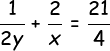 --- (B)
Solve for y and x.
How do you go about it?
Look scary, right?
But like what I said, looks can be deceiving. Use the brain to go around the issue!
Tips: The structure of the simultaneous equations looks similar to the conventional type.
(Conventional type:-
Ax + By = nn
Cx + Dy = kk )
So what we have to do can be to simply substitute by m, and
  by h (or any variable name).
What we thus convert to is:
 ---- (A)
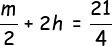 --- (B)
Will this simultaneous equations be more comfortable to solve?
Hence, a simple twist to the former mathematical questions can result in a totally familiar situations where we have solve many a times.
Thus, the technique and usefulness of substitution cannot be under-estimated.
It can be powerful at times to reveal a beautiful mathematical expression for user to resolve.
Maths Is Interesting!
Treasure our brain and our thinking.
:-)
Let's look at a "complex" simultaneous equations maths problem, and its way of solving (suggested).
Question:
Solve for y and x.
How do you go about it?
Look scary, right?
But like what I said, looks can be deceiving. Use the brain to go around the issue!
Tips: The structure of the simultaneous equations looks similar to the conventional type.
(Conventional type:-
Ax + By = nn
Cx + Dy = kk )
So what we have to do can be to simply substitute
What we thus convert to is:
Will this simultaneous equations be more comfortable to solve?
Hence, a simple twist to the former mathematical questions can result in a totally familiar situations where we have solve many a times.
Thus, the technique and usefulness of substitution cannot be under-estimated.
It can be powerful at times to reveal a beautiful mathematical expression for user to resolve.
Maths Is Interesting!
Treasure our brain and our thinking.
:-)
Sunday, 30 October 2011
Zippy Graphical Maths
Trigonometry is a fun topic in maths.
It generates curves more than many other topics.
By combining various trigonometrical functions, you can get interesting patterns on a graph.
Putting these functions on an algebraic expression produces even exciting diagram.
Below is one I created and an array of zips appears.

Enjoy maths.
maths is interesting!
.
It generates curves more than many other topics.
By combining various trigonometrical functions, you can get interesting patterns on a graph.
Putting these functions on an algebraic expression produces even exciting diagram.
Below is one I created and an array of zips appears.

Enjoy maths.
maths is interesting!
.
Friday, 9 September 2011
Math Challenge 24
Math does not purely involve writing mathematical expression .
Sometime what you need is some logically deduction base on, of course, some mathematical principles.
Below is one good example of "deduction" type of math solving.
Let start the challenge, and have some fun!

Sometime what you need is some logically deduction base on, of course, some mathematical principles.
Below is one good example of "deduction" type of math solving.
Let start the challenge, and have some fun!

Above you will find 3 squares.
Do note that the 2 yellows are of the same area and 1 blue of area bigger than the yellow ones.
If the total area of the 3 squares are 57 sq cm, determine the area of the bigger blue square.
I believe you will enjoy this math question.
.
Wednesday, 25 May 2011
Using Units to Deduce Maths Formula
There are times when we cannot remember some simple formula for a maths application.
Or we have doubts to the some maths working especially when many parameters got involved.
I ave a simple tip.
Look at the units for the numerical item.
Example:
To calculate distance travelled by a vehicle, given the speed it goes and time taken,
we look at the speed's units.
Unit: m / s
What does it tell?
Yes, it gave an indirect answer that speed = distance / time.
Thus if time is given, we are able to know that we just need to multiple speed by time in order to retain only the distance.
(m / s) x s = m (only) ==> Distance
The above allow us to use units to deduce the working (and formula).
Hence, we should not overlook the power of knowing units.
It is simply disappointing to sometimes see people missing out on writing the units for certain parameters. Maths loses its value simply by ignoring this step.
Therefore treasure this little but powerful "units".
:-)
Maths is interesting!
.
Or we have doubts to the some maths working especially when many parameters got involved.
I ave a simple tip.
Look at the units for the numerical item.
Example:
To calculate distance travelled by a vehicle, given the speed it goes and time taken,
we look at the speed's units.
Unit: m / s
What does it tell?
Yes, it gave an indirect answer that speed = distance / time.
Thus if time is given, we are able to know that we just need to multiple speed by time in order to retain only the distance.
(m / s) x s = m (only) ==> Distance
The above allow us to use units to deduce the working (and formula).
Hence, we should not overlook the power of knowing units.
It is simply disappointing to sometimes see people missing out on writing the units for certain parameters. Maths loses its value simply by ignoring this step.
Therefore treasure this little but powerful "units".
:-)
Maths is interesting!
.
Monday, 14 March 2011
Watery Art using Maths Expression
Graphs are wonderful thing in the learning of maths.
Not only does it reflects visual symptom or trend in data collected, it displays, if allowed, beautiful images.
This is possible if you allow you maths juice to go free and create mathematical expressions to your fancy and view them on a graph.
Below I have created one. I visual it as water rippling through a surface (on the top view).
Hope you like this maths art of mine.
NOTE: It is created using trigonometry of circulatory expression.

Here I view a water droplet going down into the centre. It then produces ripples or waves spreading outwards in a circular manner.
Imagination ....
Maths expressing ......
:-)
.
Not only does it reflects visual symptom or trend in data collected, it displays, if allowed, beautiful images.
This is possible if you allow you maths juice to go free and create mathematical expressions to your fancy and view them on a graph.
Below I have created one. I visual it as water rippling through a surface (on the top view).
Hope you like this maths art of mine.
NOTE: It is created using trigonometry of circulatory expression.

Here I view a water droplet going down into the centre. It then produces ripples or waves spreading outwards in a circular manner.
Imagination ....
Maths expressing ......
:-)
.
Saturday, 5 March 2011
Explanation of the Elimination Method
Solving of Simultaneous equations may require one common technique called "Elimination" method.
From the name, we know that it has to eliminate or remove something from the equations.
The target is one selected variable or unknown in the mathematical equations.
However, when approaching this method, you noticed that it involved the subtraction (or addition) of equations.
The question is "Can equations be subtracted?".
And "What is the real meaning of subtracting equations?"
My answers:-
Yes, equations can of course be subtracted. Equations are like other items, e.g. apples, chairs.
The real meaning of subtracting equations is not that apparent.
The true and desired wish to subtract equations boils down to commonising a certain coefficient of a variable.
With this common coefficient, it will then be able to remove this mathematical unknown.
(It is not really the direct processing of equations, and the magical removal of variable as a result!)
We commonise the coefficient of the selected variable first before subtracting the equations in order that same items are eliminated.
Hope this clarify some doubts of new learners to simultaneous equations solvers.
Concepts have to be learned upfront without pending questions for complete understanding and smooth follow-up learning in the later stage. Seek to clarify any doubts as far as possible.
It will reduce maths anxiety and allow you to enjoy maths as a result. The reward of clearing any doubts cannot be spelled out in words but through actual working and practice with proper analysis.
I believe you support this notion.
Cheers to maths.
.
From the name, we know that it has to eliminate or remove something from the equations.
The target is one selected variable or unknown in the mathematical equations.
However, when approaching this method, you noticed that it involved the subtraction (or addition) of equations.
The question is "Can equations be subtracted?".
And "What is the real meaning of subtracting equations?"
My answers:-
Yes, equations can of course be subtracted. Equations are like other items, e.g. apples, chairs.
The real meaning of subtracting equations is not that apparent.
The true and desired wish to subtract equations boils down to commonising a certain coefficient of a variable.
With this common coefficient, it will then be able to remove this mathematical unknown.
(It is not really the direct processing of equations, and the magical removal of variable as a result!)
We commonise the coefficient of the selected variable first before subtracting the equations in order that same items are eliminated.
Hope this clarify some doubts of new learners to simultaneous equations solvers.
Concepts have to be learned upfront without pending questions for complete understanding and smooth follow-up learning in the later stage. Seek to clarify any doubts as far as possible.
It will reduce maths anxiety and allow you to enjoy maths as a result. The reward of clearing any doubts cannot be spelled out in words but through actual working and practice with proper analysis.
I believe you support this notion.
Cheers to maths.
.
Sunday, 16 January 2011
Simultaneous Equations - Decimal Numbered
In the learning of maths, questions grow challenging as one progress upwards.
One such example is the solving of simultaneous equations.
The easy type:
Solve for x and y using elimination method.
4x + 3y = 10 ---- (1)
3x + 4y = 11 ---- (2)
For the above problem can be solved easily by selecting a coefficient to be commonised.
The post of elimination method is reference here for review.
But moving on (higher) with more challenging maths question ... we may get the below.
0.4x + 0.3y = 1 ---- (A)
3x + 4y = 11 ---(B)
What should we do next?
Equation (A) may seems unusual. It is in decimal form!
But as the blog title claims "Maths Is Interesting!", we should not be worried.
This type of question is actually not new in concept or tricky as it seems.
It is there to test you understanding by being "different".
We have to remove the "catch", which is to change the decimated number to integer.
How we do it here is simply multiplying the coefficients by 10.
This makes equation (A) to be 4x + 3y = 10 (back to the original first set of simultaneous equations at the start of this post.
The above example serves to illustrate the simplicity of changing numbers to suit the condition for easy solving. (Other questions may be multiply by another decimal number, or integer).
Just have a clear mind and a confidence attitude will be enough to allow you to solve most of the maths questions.
Try it and you will believe what I say (or write).
Maths is interesting!
.
One such example is the solving of simultaneous equations.
The easy type:
Solve for x and y using elimination method.
4x + 3y = 10 ---- (1)
3x + 4y = 11 ---- (2)
For the above problem can be solved easily by selecting a coefficient to be commonised.
The post of elimination method is reference here for review.
But moving on (higher) with more challenging maths question ... we may get the below.
0.4x + 0.3y = 1 ---- (A)
3x + 4y = 11 ---(B)
What should we do next?
Equation (A) may seems unusual. It is in decimal form!
But as the blog title claims "Maths Is Interesting!", we should not be worried.
This type of question is actually not new in concept or tricky as it seems.
It is there to test you understanding by being "different".
We have to remove the "catch", which is to change the decimated number to integer.
How we do it here is simply multiplying the coefficients by 10.
This makes equation (A) to be 4x + 3y = 10 (back to the original first set of simultaneous equations at the start of this post.
The above example serves to illustrate the simplicity of changing numbers to suit the condition for easy solving. (Other questions may be multiply by another decimal number, or integer).
Just have a clear mind and a confidence attitude will be enough to allow you to solve most of the maths questions.
Try it and you will believe what I say (or write).
Maths is interesting!
.
Wednesday, 8 December 2010
Decimal Number Simplification
.
Algebraic expressions and equations normally come in integer or fraction form.
Examples:
1) 4x - 3 = x
2) (3/4)x - 3x = 1/(3x)
Simplification of the above examples will not pose much of a problem except maybe in the challenge of bringing the numbers and unknowns over the "equal" sign.
But algebraic equations can come in decimal form too.
Example:
0.3(0.2x - 1) = 0.1x
How do we go about solving the above "decimated" algebraic equation easily?
A simple trick that I can think of (or maybe too simply a technique to call it 'trick").
What I would do is to multiply the expression on both sides by 10.
The idea is to bring the decimal number into the integer range.
BUT do note that the expression on the left side has two decimal numbers.
As such I would have to "x 10" twice.
This means that there is a "x 100" on the left and right side.
The new equation will thus be:
3 (2x - 10) = 10 x
==> 6x - 30 = 10x
==> -30 = 10x - 6x = 4x
==> x = -30 / 4 = -7.5
Conclusion:
Decimal can be seen to be intimidating when in the decimal form. However, it can be elevated to the familiar integer form through simple multiplication.
However, do take note of how many decimal number has been multiplied.
Left and right sides of the equation has to have the same number of multiplication (or division) to stay equal and valid.
Maths is not that frightening.
It can be interesting, if the method to "attack" it is properly done.
:-)
Algebraic expressions and equations normally come in integer or fraction form.
Examples:
1) 4x - 3 = x
2) (3/4)x - 3x = 1/(3x)
Simplification of the above examples will not pose much of a problem except maybe in the challenge of bringing the numbers and unknowns over the "equal" sign.
But algebraic equations can come in decimal form too.
Example:
0.3(0.2x - 1) = 0.1x
How do we go about solving the above "decimated" algebraic equation easily?
A simple trick that I can think of (or maybe too simply a technique to call it 'trick").
What I would do is to multiply the expression on both sides by 10.
The idea is to bring the decimal number into the integer range.
BUT do note that the expression on the left side has two decimal numbers.
As such I would have to "x 10" twice.
This means that there is a "x 100" on the left and right side.
The new equation will thus be:
3 (2x - 10) = 10 x
==> 6x - 30 = 10x
==> -30 = 10x - 6x = 4x
==> x = -30 / 4 = -7.5
Conclusion:
Decimal can be seen to be intimidating when in the decimal form. However, it can be elevated to the familiar integer form through simple multiplication.
However, do take note of how many decimal number has been multiplied.
Left and right sides of the equation has to have the same number of multiplication (or division) to stay equal and valid.
Maths is not that frightening.
It can be interesting, if the method to "attack" it is properly done.
:-)
Monday, 22 November 2010
Basic Decimal Conversion
`
Every thing falls back to basic.
If the fundamentals are weak, any maths learners will have a hard time moving forward in their maths learning journey.
Let me quote an example.
How do we change 4.75 to fraction.
We can use 475 / 100 and reduce it through long division. This will give 4 and 3/4.
However, if we know that 4.75 is actually consisting of 4 add to 0.75, the conversion will be simpler.
4 and 0.75 means 4 + (3/4) which leads directly to 4 whole and 3/4. Same as answer of above.
(NOTE: 0.75 is a quarter which equates to 3/4).
Simple isn't it?
Maths is interesting.
:-)
Every thing falls back to basic.
If the fundamentals are weak, any maths learners will have a hard time moving forward in their maths learning journey.
Let me quote an example.
How do we change 4.75 to fraction.
We can use 475 / 100 and reduce it through long division. This will give 4 and 3/4.
However, if we know that 4.75 is actually consisting of 4 add to 0.75, the conversion will be simpler.
4 and 0.75 means 4 + (3/4) which leads directly to 4 whole and 3/4. Same as answer of above.
(NOTE: 0.75 is a quarter which equates to 3/4).
Simple isn't it?
Maths is interesting.
:-)
Sunday, 3 October 2010
Pointers in Teaching, Learning Speed
.
At elementary level in maths education, speed is always a challenging topic for learners.
It caught my attention and I started wondering why?
Many mistakes can be made when dealing with these types of questions.
After studying the various mistakes made by learners, I came to a few conclusion that I like to share here.
How to avoid confusion in doing Speed questions in maths:-
1) Speed involves two parameters, namely, distance and time.
This is the key issue. Dealing with one parameter is already a challenge, and dealng with two is always a "headache".
The concept, has thus to be clearly addressed upon, before the ratio of distance and time leading to speed can be fully understood.
What is distance?
What is time?
These 2 items are variable in nature. They change in value.
They causes confusion when lumped together!
Examples of daily activities will help in this case.
Quote cases like running in a race, where the champion came back in the shortest time covering the same distance as all others.
Get the concept of distance versus time into them.
Also FAST and SLOW relation to speed.
2) Error in units:-
Break up the tasks of calculating km, m or cm and sec, hours, minutes separately.
In other words,deal with one item at a time.
Use basic unit if possible to reduce chances of making costly errors.
The learners have to handle the logical part of the question, and also the mechanical part of unit manipulation in speed problems.
Tell them to find one thing at a time, and the need for doing that. Be patience is the message.
3) Draw out a pictorial image of the question.
This method will help some kids to visualise the real issue.
By having drawn the length for distance to be covered (or covered), they will have a better idea of what distance is about in the maths question. They will not have to "keep" this disatnce in their mind together with the problematic "time" condition.
Use the seeing method helps them clear any doubts and can also reduce mistakes in interpreting the question.
There will definitely be more pointers to be added to my three above.
But with these 3 basic issues settled, most of the queries about speed and its maths problems should be clearer.
If you have any other pointers, you may share in the comment space.
Cheers :-)
Maths is interesting, I suppose you cannot agree more.
.
At elementary level in maths education, speed is always a challenging topic for learners.
It caught my attention and I started wondering why?
Many mistakes can be made when dealing with these types of questions.
After studying the various mistakes made by learners, I came to a few conclusion that I like to share here.
How to avoid confusion in doing Speed questions in maths:-
1) Speed involves two parameters, namely, distance and time.
This is the key issue. Dealing with one parameter is already a challenge, and dealng with two is always a "headache".
The concept, has thus to be clearly addressed upon, before the ratio of distance and time leading to speed can be fully understood.
What is distance?
What is time?
These 2 items are variable in nature. They change in value.
They causes confusion when lumped together!
Examples of daily activities will help in this case.
Quote cases like running in a race, where the champion came back in the shortest time covering the same distance as all others.
Get the concept of distance versus time into them.
Also FAST and SLOW relation to speed.
2) Error in units:-
Break up the tasks of calculating km, m or cm and sec, hours, minutes separately.
In other words,deal with one item at a time.
Use basic unit if possible to reduce chances of making costly errors.
The learners have to handle the logical part of the question, and also the mechanical part of unit manipulation in speed problems.
Tell them to find one thing at a time, and the need for doing that. Be patience is the message.
3) Draw out a pictorial image of the question.
This method will help some kids to visualise the real issue.
By having drawn the length for distance to be covered (or covered), they will have a better idea of what distance is about in the maths question. They will not have to "keep" this disatnce in their mind together with the problematic "time" condition.
Use the seeing method helps them clear any doubts and can also reduce mistakes in interpreting the question.
There will definitely be more pointers to be added to my three above.
But with these 3 basic issues settled, most of the queries about speed and its maths problems should be clearer.
If you have any other pointers, you may share in the comment space.
Cheers :-)
Maths is interesting, I suppose you cannot agree more.
.
Sunday, 13 June 2010
Simple Logarithm Tip
.
Maths expression may at times look challenging, but a bit of a thought may make it otherwise.
Logarithm is always an exciting topics to new learners.
With the "log" coming into the maths expression, one will be confused.
Definitely!
But do rest assure, as the tip below shows.
Maths Tip
eln y = y
Proving this:
"Natural log" both sides will give ln eln y = ln y
Applying the law that ln an = n ln a, and that ln e = 1, you will notice that the above mathematical expressions are true and equal.
NOTE:
This tip applies to "log" too.
10log y = y
Hope this helps.
:-)
Maths expression may at times look challenging, but a bit of a thought may make it otherwise.
Logarithm is always an exciting topics to new learners.
With the "log" coming into the maths expression, one will be confused.
Definitely!
But do rest assure, as the tip below shows.
Maths Tip
eln y = y
Proving this:
"Natural log" both sides will give ln eln y = ln y
Applying the law that ln an = n ln a, and that ln e = 1, you will notice that the above mathematical expressions are true and equal.
NOTE:
This tip applies to "log" too.
10log y = y
Hope this helps.
:-)
Wednesday, 2 June 2010
Model versus Variable Technique
'
In using Model method of solving maths question, we are using visual blocks to scope our thinking. This is followed by analysis through the models.
Models become a link to our thinking process.
The demerit is when we did not create the Model properly, or miss out some details that cause the model to be represented wrongly.
The merit is that it can be simple and straight forward when drawn properly. It reflects outright the relationship between many unknowns.
Less workings is thus needed, as visual que sets in.
For algebraic variable technique, the unknowns are pre-defined and booked as "letters". A space, mentally, has been reserved for the answer.
The working is just simply to accept that the answer is already there but only not numerical. Following through the working steps will ultimately reveal the letter of its numerical data which is what we want.
Variable as letter is good in the sense that we need less analysis, but just mechanically following the rules and steps leading to the final step, of course with some logic and mathematical strategy.
Each has its own advantages and weakness. It is up to us to make use of them in the correct way.
Experience is the only way to overcome the proper selection of which technique.
Thus practice to gain experience in maths is one good way to master maths.
Skiving is a no-no.
Through practice, you will sooner or later find that maths is interesting.
:-)
In using Model method of solving maths question, we are using visual blocks to scope our thinking. This is followed by analysis through the models.
Models become a link to our thinking process.
The demerit is when we did not create the Model properly, or miss out some details that cause the model to be represented wrongly.
The merit is that it can be simple and straight forward when drawn properly. It reflects outright the relationship between many unknowns.
Less workings is thus needed, as visual que sets in.
For algebraic variable technique, the unknowns are pre-defined and booked as "letters". A space, mentally, has been reserved for the answer.
The working is just simply to accept that the answer is already there but only not numerical. Following through the working steps will ultimately reveal the letter of its numerical data which is what we want.
Variable as letter is good in the sense that we need less analysis, but just mechanically following the rules and steps leading to the final step, of course with some logic and mathematical strategy.
Each has its own advantages and weakness. It is up to us to make use of them in the correct way.
Experience is the only way to overcome the proper selection of which technique.
Thus practice to gain experience in maths is one good way to master maths.
Skiving is a no-no.
Through practice, you will sooner or later find that maths is interesting.
:-)
Thursday, 27 May 2010
Purpose of Variables in Algebra
'
Unknowns are literally unknowns.
In maths, these unknowns are a cuause formaths anxiety.
When you are in unfamiliar territory, you will naturally be uncomfortable and unease.
This is the same feelingwhen dealing with unknowns in maths.
Algebra came to the rescue for this problems.
Here, you will find unknowns named as "variables".
They served as "parking lots" for the final answers or unknowns.
In this algebra, you replace the variables for final numbers and work with them as though you already know them.
You simply go through the motion of solving the question with any given condition and numbers / data.
Upon finally reaching the last step, the numerical answers for the problem will be revealed.
This is the power of the variables in algebra.
Just simply work along, and not be fearful of the unknowns.
The steps will align you to the final answers.
Cheers!
Maths is interesting!
.
Unknowns are literally unknowns.
In maths, these unknowns are a cuause formaths anxiety.
When you are in unfamiliar territory, you will naturally be uncomfortable and unease.
This is the same feelingwhen dealing with unknowns in maths.
Algebra came to the rescue for this problems.
Here, you will find unknowns named as "variables".
They served as "parking lots" for the final answers or unknowns.
In this algebra, you replace the variables for final numbers and work with them as though you already know them.
You simply go through the motion of solving the question with any given condition and numbers / data.
Upon finally reaching the last step, the numerical answers for the problem will be revealed.
This is the power of the variables in algebra.
Just simply work along, and not be fearful of the unknowns.
The steps will align you to the final answers.
Cheers!
Maths is interesting!
.
Saturday, 24 April 2010
A Mathematical Waterfall
'
Mathematics equation can be fun.
It is not only used as a problem-solving tool, it can be used to create visual image simulating scene.
By trying a few equations, anyone with patience and basic maths knowledge can do it.
Simply create an expression or equation in a graph and tweet it to form any image.
Here you will see an image formed up to look like a waterfall.
Enjoy yourself.
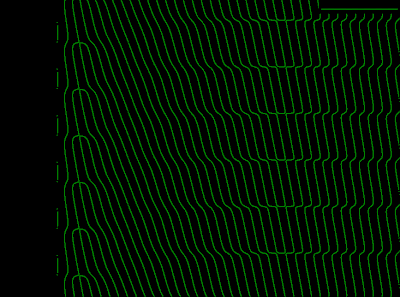
This was done with both logarithm and trigonometry functions.
:-)
Mathematics equation can be fun.
It is not only used as a problem-solving tool, it can be used to create visual image simulating scene.
By trying a few equations, anyone with patience and basic maths knowledge can do it.
Simply create an expression or equation in a graph and tweet it to form any image.
Here you will see an image formed up to look like a waterfall.
Enjoy yourself.
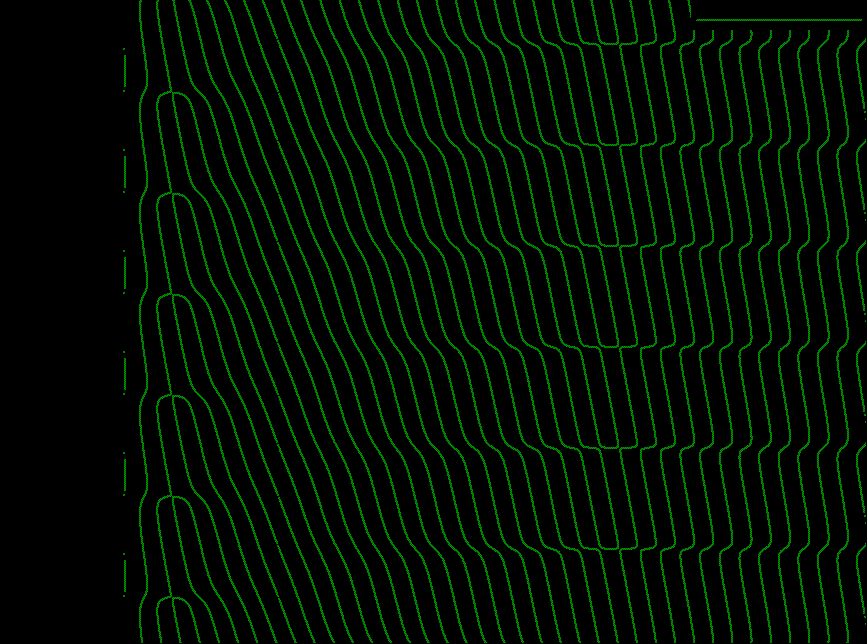
This was done with both logarithm and trigonometry functions.
:-)
Wednesday, 14 April 2010
Maths Symbol in Our Applications
.
There are many symbols in maths.
To learn and understand maths, we need to know the meaning of the symbols.
This is very much like talking to a foreigner. Without understanding each other's language, no communication can be carried out (other than the international body language!)
Hence, knowing the usage of the symbols in a mathematical expression helps.
But is it really so?
Partially.
Why do I say that?
Yes, you may know the symbol while doing maths, but if the same symbol is used elsewhere, do you still understand?
One example is:
y = x + 1
This means x is added by one and their total is represented by the variable "y".
This is for the maths operator "+".
But what about the expression x++ ?
This looks odd, isn't it?
To the maths learner, this may be a typo error, or something is missing.
"x++" is actually commonly used in C programming.
What it means is x = x + 1.
It is a short-cut way of writing the addition of x and replacing it by the same variable "x".
Thus this example showed the use of "+" in another application.
It is still maths in some sense, but written in another form.
Maths is therefore always around us. It is a matter of us applying them and understanding them.
Only by learning their "language", can we communicate with them.
Interesting? I bet you agree!
Other applications can be " += ", " :-) " and " x>>4 ".
Can you find their meaning?
:D
There are many symbols in maths.
To learn and understand maths, we need to know the meaning of the symbols.
This is very much like talking to a foreigner. Without understanding each other's language, no communication can be carried out (other than the international body language!)
Hence, knowing the usage of the symbols in a mathematical expression helps.
But is it really so?
Partially.
Why do I say that?
Yes, you may know the symbol while doing maths, but if the same symbol is used elsewhere, do you still understand?
One example is:
y = x + 1
This means x is added by one and their total is represented by the variable "y".
This is for the maths operator "+".
But what about the expression x++ ?
This looks odd, isn't it?
To the maths learner, this may be a typo error, or something is missing.
"x++" is actually commonly used in C programming.
What it means is x = x + 1.
It is a short-cut way of writing the addition of x and replacing it by the same variable "x".
Thus this example showed the use of "+" in another application.
It is still maths in some sense, but written in another form.
Maths is therefore always around us. It is a matter of us applying them and understanding them.
Only by learning their "language", can we communicate with them.
Interesting? I bet you agree!
Other applications can be " += ", " :-) " and " x>>4 ".
Can you find their meaning?
:D
Saturday, 10 April 2010
Number of Answers | Common mistake
Maths can be tricky when you are not careful.
This is not to frighten you, though.
This post is just to remind you of the wonderful aspect of maths in covering all areas.
Below is an example of what I meant.
Let's take the quadratic eqaution solving as a starting point
x2 = 5x
x = 5x / x = 5 (Answer)
At first, this looks pretty fine. The answer, when substituted back, produces match of equation.
But this is actually not complete.
Those doing quadratic equation will know 2nd order (x2) equation evaluates to 2 answsers.
The answers may be the same though.
Now, if we approach it using another method, let's see the different.
x2 - 5x = 0
==> x (x - 5) = 0 , after factorising
==> x = 0 and (x - 5) = 0
==> x = 0 and x = 5
There are two answers now.
We had the x = 5 initially, but what about this new x = 0.
We have missed out on the x = 0 with the first mehtod. It looks OK then.
What happen?
It may be due to lack of experience handling this form of maths question.
The concept in solving quadratic equation is actually not limited to second order.
The hidden message is depending on the order, the number of answers will follow suit.
What I meant is :
2nd order gives 2 answers,
3rd order gives 3 answers,
4th order gives 4 answers, etc.
It is this verry message that maths learner should capture. Otherwise you will be tricked to give only one answer which leads you to "mistakes" of being incomplete.
I agree that this is tricky, but within reasonable argument.
If a student practice hard (and smart), he will not fall prey to this type of simple math problem.
Do not get con again.
Enjoy maths. It's fun and interesting.
:D
This is not to frighten you, though.
This post is just to remind you of the wonderful aspect of maths in covering all areas.
Below is an example of what I meant.
Let's take the quadratic eqaution solving as a starting point
x2 = 5x
x = 5x / x = 5 (Answer)
At first, this looks pretty fine. The answer, when substituted back, produces match of equation.
But this is actually not complete.
Those doing quadratic equation will know 2nd order (x
The answers may be the same though.
Now, if we approach it using another method, let's see the different.
x2 - 5x = 0
==> x (x - 5) = 0 , after factorising
==> x = 0 and (x - 5) = 0
==> x = 0 and x = 5
There are two answers now.
We had the x = 5 initially, but what about this new x = 0.
We have missed out on the x = 0 with the first mehtod. It looks OK then.
What happen?
It may be due to lack of experience handling this form of maths question.
The concept in solving quadratic equation is actually not limited to second order.
The hidden message is depending on the order, the number of answers will follow suit.
What I meant is :
2nd order gives 2 answers,
3rd order gives 3 answers,
4th order gives 4 answers, etc.
It is this verry message that maths learner should capture. Otherwise you will be tricked to give only one answer which leads you to "mistakes" of being incomplete.
I agree that this is tricky, but within reasonable argument.
If a student practice hard (and smart), he will not fall prey to this type of simple math problem.
Do not get con again.
Enjoy maths. It's fun and interesting.
:D
Subscribe to:
Posts (Atom)
+copy.jpg)


 Posts
Posts


